
The Witch of Thornvale: The complete second act
The Witch of Thornvale is a literary portal fantasy featuring two distinct characters. It allegorizes Ludwig von Mises’ Six Lessons.
Need to get caught up on The Witch of Thornvale? Catch the complete first act if you haven’t read it yet. Below, you’ll find all of Act II — Chapters 7 to 15. Catch the epic climax, and see how the stage gets set for what will be an explosive Act III.
Chapter 7: A Different Kind of War
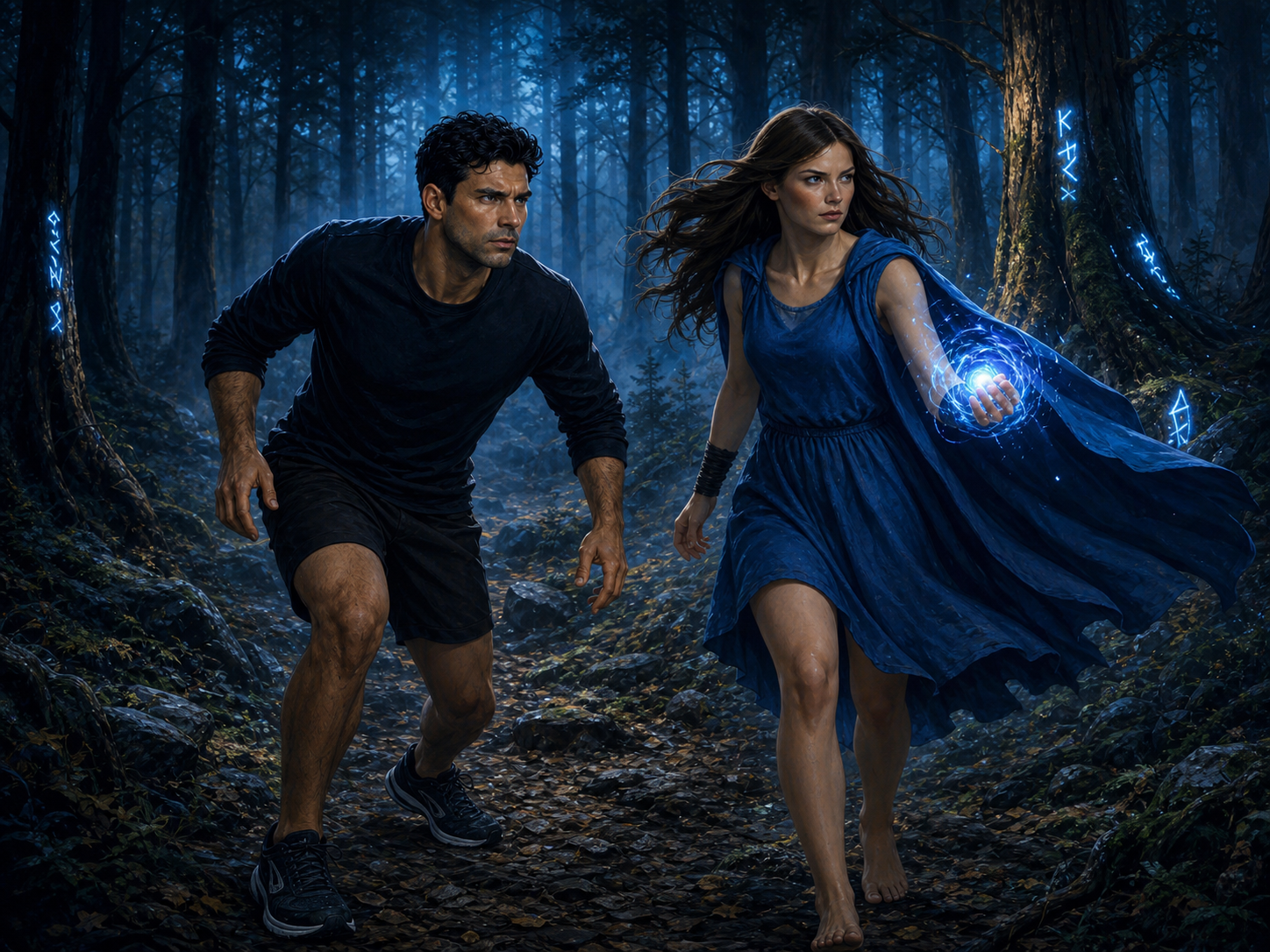
Thorns tugged at Drake’s sleeves. Thin vines wrapped around his ankles like the woods meant to drag him under. Each footfall sank into black loam that a recent rain softened. The brush closed in with every step, dense enough to block the sky.
Branches clawed Drake’s chest and slapped across his face. He pushed forward without breaking stride. Behind them, the village receded into the trees.
Eirwyn moved ahead, cloak grazing the underbrush, her stride low and deliberate. Every few paces, she stopped. One hand reached up to the treetops, fingers skimming bark. Her eyes flicked toward the limbs above, tracking sway, reading tension in the branches like a soldier anticipating an ambush.
She turned into the wind, lips parted, as though listening for voices that traveled on air.
Drake followed through the knot of saplings and ferns, breath tight in his chest. The hill sloped upward, the ground unstable with gravel and half-buried roots. He climbed, his sneakers grinding soil into mud.
At the ridge, he exhaled like he’d just finished a marathon. “That place felt worse than war.”
Eirwyn’s toes shifted in the moss. She turned her head partway, just enough for the wind to catch her hair. “It is war.” Her voice struck like flint.
Drake watched the mist drift across the hollow below. It crept low to the ground, easing upward until its moisture wrapped around his shins.
They continued onward, sneakers and bare feet pressing forward into the unknown.
The brush gave way to a jagged stone shale layered in slabs. Moss clung to the cracks and pale lichen patterned the rock. Eirwyn climbed first, her fingers catching edges, each motion fluid and exact.
Drake’s palms braced rough ledges. He pulled himself up beside her, sneakers scraping the stone until he reached the shelf where she crouched. The forest below stretched wide, with mist curling through the canopy. From up here, the silence felt thicker.
Eirwyn sank to the ground, knees folded tight to her chest. Her breathing slowed in rhythm with the wind whistling across the ledge. She leaned against a tilted stone slab, eyes scanning the sky through the twisted branches overhead. The slow grind of survival unwinding, one breath at a time.
Drake lowered himself beside her, back to the rock, elbows propped on his knees. Sweat glued his Sabres shirt to his spine. His heart slowed from a gallop to a crawl. The climb drained him, but not nearly as much as the silence between them.
Eirwyn reached for the clasp at her collar.
The blue material came loose with a soft snap, falling open just enough to reveal the edge of her ribs. Her hand slipped beneath the fabric, fingertips brushing something dark beneath the skin.
Drake turned toward her, words half-formed.
Then he saw it.
A brand. Faint, but brutal. A jagged rune carved just under her left side—blackened, split by scar tissue. The lines didn’t match the neat etchings from the shop mirror. This mark looked torn. Botched. Like someone had tried to break her and missed the kill shot.
She rubbed the scar like it itched. The motion looked automatic, as if her body had memorized the pain. “Malcor’s people nearly caught me once,” she said, voice low. “I escaped.” Her fingers traced the edge of the rune. “Most don’t.”
Drake stared, chest hollowing. His words caught in his throat and stayed there.
“My parents hid me in the root cellar. They told me to wait until morning. Said they’d come for me once the sun touched the garden wall.” Her lips pressed together. “I heard my mother scream first. Then my father. I didn’t leave the cellar until the next day. I stepped over their bodies.”
Drake shifted against the stone. The cool rock pressed against his spine, anchoring him.
“They set fire to the place. Not to burn it down like they usually do; just to smoke me out. When I was forced out, they grabbed and tried to brand me, but I fought them off.” Her hand left the brand and dropped to her side. “I’ve been moving ever since, with no full nights of sleep.”
A breeze picked up, pulling strands of hair across her face. She pushed them back without thought. “The worst part isn’t the running. It’s the waiting. The wondering which stranger’s going to turn me in. Who watched me too long, and who saw the glow when I risked some magic.”
She turned and her eyes met Drake’s. “People think war is armies, banners, and blood in the dirt. But it starts quieter than that.”
Drake leaned forward, elbows on his knees. The fire in his legs from the climb still burned, but his body barely registered it.
“It starts when survival becomes guilt. When staying alive means leaving others behind.”
Drake’s eyes lingered on the rune, then he looked away.
He sat forward, arms resting across his knees, fingers curling into the creases of his shorts. The lichen on the stone beneath him flaked under the weight of his sneakers. Mist drifted past the ledge, tugged by a wind. The silence pressed harder now, no longer a reprieve but an expectation.
He stared past the tree line, past the twisted branches and the thin gray horizon bleeding into the canopy.
“My world has all the tools,” he said, voice sharp and low. “Every device and platform. Instant access to more information than you could process in ten lifetimes. We’re drowning in it, and no one uses it.”
Eirwyn turned, slow and deliberate, cloak slipping back across her shoulders. Her knees tucked close to her chest, arms looped tight. The brand across her ribs vanished beneath the fabric again.
Drake exhaled hard through his nose. “You speak out, and the algorithms bury you. You question anything, and they shove your face into a wall of noise until you fold.” He rubbed the side of his jaw, fingers catching against stubble roughened from sweat and cave grit.
“They don’t need enforcers. They have metrics, ad dollars, and social shame. You lose your job for wrongthink, you get flagged, shadowbanned, and de-platformed. In some places, your bank will cancel your account.” His voice cracked at the edge with raw and sour frustration. “They don’t send men with swords. They just flip a switch.”
Eirwyn blinked slowly.
Drake leaned back against the stone, spine scraping moss from the wall. The cold bled through his shirts.
“I started a blog. Under a pen name. Wrote about the things no one wanted to touch—real liberty, actual decentralization, and what happens when you let institutions define morality.” He stared at his hands. “It took off fast. People started reading, sharing, and every time I logged in, I thought about using my name real name. One they’d recognize from my sports writing.” His knuckles whitened. “But I didn’t. I kept using the name Sion Fawkes. A voice behind a wall. It was freaking cowardice.”
Eirwyn shifted her weight. The stone cracked faintly beneath her heel. She watched him, eyes scanning his face, measuring something behind the words. “You still chose to say something.” Her tone cut clean, like a blade honed against truth.
Drake looked over, and caught the fire behind her stare. The kind that doesn’t burn the skin—just the excuses.
He looked away first. “I could afford to. That’s the part I hate the most.”
A single raven cried from somewhere below the ridge. The sound echoed upward, hollow as a threat left unanswered.
The dying sun peeked from behind the clouds through the gap in the trees and cut sideways across the ridge, bleeding through veils in streaks of blue and silver. The light sliced—cold and sharp, dragging long shadows across the stone outcrop where Drake and Eirwyn sat.
Drake rested with his elbows braced on his knees, eyes locked on the gnarled forest below. The quiet rustle of leaves, the distant cry of birds shaped like nightmares, and the wind carving its path through branches like it had somewhere better to be.
Eirwyn’s cloak fluttered behind her. She stood, one foot braced on the rock ledge, arms folded across her ribs. Her toes curled slightly into the lichen-streaked stone as she looked out, not like someone appreciating the view, but someone tracking what might try to catch her next.
Drake broke the silence first. “Your world shackles the body. Mine shackles the mind.”
Eirwyn turned, slow and deliberate. “You said your people live surrounded by light. With tools to see the truth. And yet…”
Drake’s lip twitched. “They look down at the chain and call it jewelry.”
Eirwyn stepped down from the ledge, her feet scraping over loose stone. She crouched by a knot of exposed root and ran her fingers across the bark. “Here, the Crown brands you. They come with steel and fire. Everyone sees the threat, and knows what it costs.”
She turned her hand palm-up. The scar along her ribs caught the light again as her cloak shifted. “In your world the cage is invisible. That makes it harder to break.”
Drake stared past her into the forest, brow furrowed deep. His voice came tight. “Here, they beat your body. There, they buy your soul.”
Eirwyn rose, hand falling to her side. Her cloak flared slightly in the wind, the blue material stained at the hem with moss and grit. She gazed into the treetops, where faint birdsong called like an echo trying to remember its source. “It sounds like they pay in comfort. And they accept the cost because the collar fits snug. Because it doesn’t chafe right away.”
Drake shifted, and rocks rolled under his sneakers. “They say you’re free, as long as you obey. They’ll let you scream—just not too loud. They’ll let you fight—just not where it matters.”
He stood and paced to the edge of the overlook, arms folded across his chest, fingers twitching near the logo stitched across his sleeve. “They built a prison, then handed us the blueprints and told us we were architects.”
Eirwyn’s expression didn’t change. “The conscripts. At least they know they’re slaves.”
Drake took a slow breath, eyes locked on the trees far below where fog drifted. “People back home think submission is civility. They think obeying orders makes them virtuous.”
His voice sharpened, a knife edge dragging through each word. “They stopped farming, stopped building, and stopped fixing things themselves. They wait for the State to solve hunger, hate, and climate. And when nothing gets better, they thank it anyway. Like it’s a god made of policy briefs.”
Eirwyn crouched again, brushing her hand across a patch of dirt. She took nearby branches and merged them into a pile. “Malcor says he protects us. Then he starves towns that forget to praise him.”
Drake turned back. “They say free speech is hate speech where I’m from. But real violence? That’s just unfortunate context.”
Their eyes met. Wind coiled around them, stirring leaves into eddies.
“Fear.” Eirwyn eased herself upward and brushed moss from her knee. “That’s the mortar.”
Drake’s mouth pulled into something too tired to be a smile. “Obedience disguised as virtue. Same walls. Different bricks.”
They stood at the edge of the overlook. Below, the forest stretched wild and tangled, untouched by taxes or tribunals. Somewhere down there, the Crown waited for one of them to slip. Somewhere far away, Drake’s world pulsed with artificial light and silent screens.
A small array of embers ignited from Eirwyn’s fingertips, and a fire snapped low in its makeshift pit, carved into the soft earth beside a cluster of wind-gnarled trees. The flames bit at the edges of half-rotted wood, sparks rising through twisted smoke that clung to the ground. Orange light crawled across Eirwyn’s face as she crouched near the fire.
Drake sat across from her on a flat chunk of rock, elbows on his knees, eyes locked on the fire’s core. The branches throbbed like veins just under the skin—too alive to ignore.
“I don’t want to fight,” Eirwyn said, her voice unwavering. “But running never stops the hunt.”
Drake picked up a stone beside his sneaker and tossed it into the dark. The thunk echoed off the trees like an accusation. “You think people in my world are soft?”
Eirwyn shifted her weight. “They’re slow. But maybe not lost.”
The wind shifted. Leaves overhead trembled. The fire bent sideways for a breath, then snapped upright again. The trees loomed, crowns knotted with black branches that clawed at the moonlight.
Drake looked up, where a few stars emerged through the haze and stared back—clearer than they ever had in Pittsburgh.
Chapter 8: A Village With Light
Drake and Eirwyn continued their trek as night fell around them, with the slope turning savage fast.
Loose shale crumbled under Drake’s sneakers. One wrong shift, and gravity would grab him by the ankles and drag him into the ravine below. Eirwyn moved ahead, light on her bare feet, cloak snagging against brambles that clung to her.
The descent wrapped them in layers of damp and silence. Vines curled like snakes over every rock—some coiled around trees, others stretched across the path like wires waiting to trip a fool.
“Step where I step.” Eirwyn brushed a twisted root with the side of her foot. “Nothing else.”
Drake nodded, voice buried behind clenched teeth. One foot forward, then the next.
The forest darkened. Shadows deepened to oil. Fungi bloomed in clumps along the base of warped trees—bulging, slick, throbbing with a soft green light that shimmered between leaves. The glow pulsed when the wind touched them, fading as Eirwyn passed.
She stopped beside a thick-barked tree shaped like a gnarled fist. Reaching up, she dragged her fingernail across the surface. A glowing rune sparked to life—rough spiral, broken loop. A crossmark slashed through the center. The light flared, then vanished.
Drake stared. “What’s it do?”
“Reminds the forest I passed through. And which way I left. It will help cover our tracks.”
A gust cut down the ravine, carrying the scent of rot and stone. Somewhere below, something bubbled. Stagnant water festered in shallow craters—slick, rainbow-surfaced, breathing the stink of sulfur and wet copper. One pool hissed as a leaf fell in. Drake turned his face from the smell and pressed forward.
The descent kept pulling, the terrain angling harder, punishing every slip. Thorns tore a line across Drake’s forearm. He caught himself against a trunk and blood beaded.
Eirwyn’s pace quickened as she wove through the unforgiving landscape.
By the time they hit the bottom, Drake’s legs shook with every step. Sweat soaked through his back and gathered in the bend of his elbows. His shirt, as it had done so often, clung like a second skin.
The ground flattened. Still brutal—but mercifully level.
A split boulder jutted from the forest floor, cracked down the center as if some giant struck it long ago. One side bore carvings—jagged lines chipped deep, weathered to near extinction. A circle broken in two. A tree without roots, and a flame-smothered stone.
Eirwyn dropped beside the boulder. She set her back against the stone and crossed her legs, her cloak curled around her. Within minutes, her breathing slowed to something rhythmic, and she shut her eyes.
Drake stayed upright longer. He sat down slow, sneakers dragging moss loose. His back found the stone, cold and familiar in its roughness. He stretched his legs until the cramps in his thighs gave way to numbness.
Above them, the stars bled sharp and brutal through the canopy. The constellations bore no names he knew.
He sat there, arms folded, tracing patterns with his eyes. The night pressed in close, cooler now and full of sounds that carried no warmth—wind through dead branches, the slow chirr of insects that refused to sleep, and the crackle of something large slipping through wet underbrush far off in the trees.

The underbrush thinned fast the next day. No more vines grabbed at Drake’s legs, and no claws of bramble bit at his sleeves. The air grew cleaner and crisper. Each breath edged with something sharp. The smell shifted too—lavender crushed underfoot, with cedar smoke curling through the branches. A strange sweetness like lightning caught in flower petals.
Eirwyn’s movements grew more pronounced, her bare feet pressing into a path Drake hadn’t seen until she walked it. She weaved between the trees like they were sentries on patrol.
He slowed as the grove opened. Trees arched inward, their trunks bent as each curve swept clockwise into a spiral. The canopy twisted above, branches overlapping with a symmetry that felt too perfect to be natural. Sunlight bled through the leaves in thin columns, gold and green, flickering across the path.
A low hum rolled through the space.
Eirwyn stepped into the spiral’s heart. The wind around her died, and her cloak dropped silent. She vanished between the trees without a ripple.
Drake paused and his palm prickled.
Heat drained from the air, and sweat chilled against his skin. The light bent wrong. It was too pale, and too still. He reached forward, fingers grazing the invisible edge. His skin buzzed. It was like brushing too close to live wire. Then he pushed through.
His breath fogged. The early-afternoon sun still touched the upper leaves, but the grove inside felt like late autumn. Wind ceased completely, and the air held its breath. Drake held his with it.
He turned to look behind him and found only trees. No sign of the trail, no sneaker or footprints, and no broken branches. Just the spiral holding its secrets.
A hawk screamed above, wings spread wide in a single pass before folding into the canopy. A bell rang in a single long tone. Metallic and faint.
Then something moved. The forest thinned again—but this time, the stillness broke with the breath of life.
Drake followed Eirwyn down a narrow incline, where the trees opened into a deep-cut ravine carved smooth by a stream that trickled loud enough that he heard it over his shoes. Moss blanketed the stone, softening each step. Ahead, rooftops peeked through the fog.
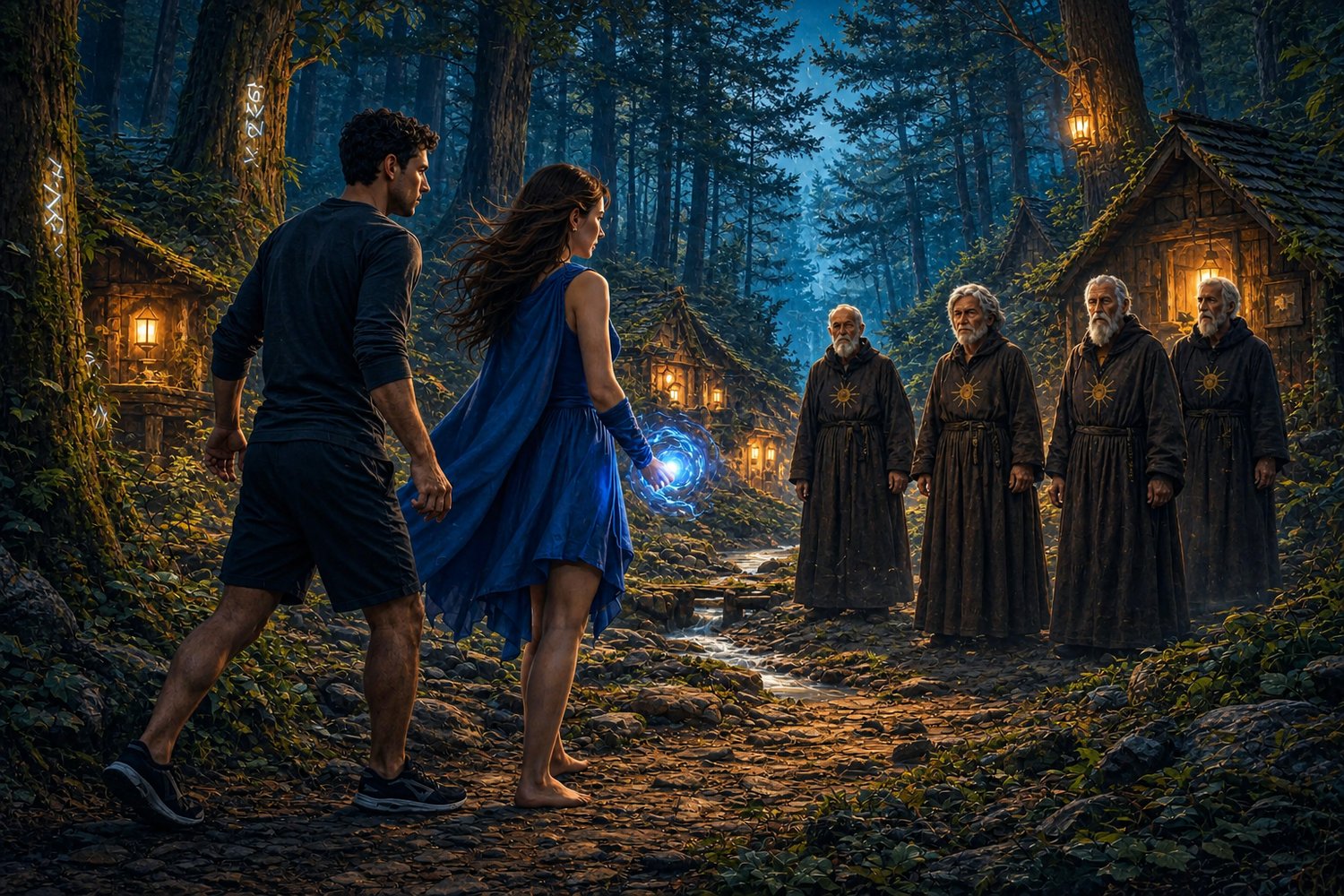
A village emerged. One that couldn’t have been more different than the village they passed through yesterday. Homes built from bark-covered planks and weather-worn timber. Ivy threaded along chimney stone, as smoke curled into the canopy in thin, spiraling columns that faded before reaching the sky.
A goat grazed near a mill, its stone arch half-swallowed by bramble. A loom sat inside the old grain room, threads stretched between beams where grain sacks hung. A bell above the door rocked in the breeze—no clapper, just wind chimes ringing high and soft, its notes cut from crystal.
They stepped between the first two homes. Covered stalls lined the edge of the path, each manned by someone hunched over a trade. Herbs dried in woven bundles, and clay pots rested on old linen. No signs bore guild crests. Just hand-carved symbols of a fox, a flame, and a fishhook.
The stream twisted behind the village. It was no wider than a car’s axle, running clear but shallow. Wooden planks bridged it.
Drake caught them in the shadows. Faces, half-lit behind door frames. Movement behind half-shuttered glass. One figure ducked back inside, leaving the curtains fluttering.
Footsteps scuffed gravel behind a shed. A thin boy—maybe fifteen—bolted down a side path, his head low, arms pumping. The bell’s echo answered him from the other side of the ravine.
Eirwyn raised her hands with her palms open and fingers relaxed. “I’m marked,” she said, her voice strong and even, “but not claimed.” Her words traveled clean. Like reciting an oath that could save or damn them both.
Somewhere deeper in the village, a few doors creaked open.
The sound of shuffling boots broke the stillness, and four figures stepped into view from opposite ends of the village, their cloaks trailing.
Drake shifted his weight, one sneaker on packed earth, the other sinking slightly into a patch of moss. He counted them without thinking—three men, one woman. None younger than sixty. Their robes hung in faded layers, homespun wool the color of smoke and sand, with an unfamiliar symbol: a sunburst torn clean through the middle.
Their eyes moved over Eirwyn, as though judging her posture, the way she stood with her arms loose but ready, the mark hidden under her cloak.
The shortest of the four stepped forward. His beard looked woven from ash, eyes pale and glassy, like ice left under moonlight too long. “Starweaver. We caught word you were on the run.”
Eirwyn nodded. “I don’t ask for sanctuary. Only silence.”
The elder tilted his head. “Your father traded here once.”
Another stepped forward. This one leaned heavier on his left boot, a limp barely masked by the sweep of his robe. His eyes skipped over Eirwyn and landed on Drake.
Then a slow scan—head to toe. From the distressed Penguins logo, his still dirt-smeared and torn shorts, to the athletic shoes caked in shale and blood-mud. The elder’s gaze hovered on the corner of the cracked iPhone peeking from his pocket. His lip curled.
Drake took a step forward, hands loose at his sides. “I’m not from here. I’m not part of the regime.” It was a stupid thing to say, but he couldn’t think of anything else.
The woman stepped in. She was taller, with bones sharp beneath sunbeaten skin stretched with age. “Every spy we’ve ever caught came smiling first.”
Drake stopped mid-breath.
The limping man grunted. “And speaking of freedom like it’s something to be gifted. Carried on the tongue like a coin for bartering.”
Drake’s mouth went dry and he was at a loss for words.
Chapter 9: Cinderglen
Eirwyn’s jaw tensed. “He’s with me. He’s been with me.”
The woman narrowed her eyes. “That may protect him…for now.”
The last elder—the quiet one, silver-bald and hunched—tapped the bottom of his staff once against the ground. He watched Drake like he was watching the edge of a storm that hadn’t made landfall yet.
Around them, more villagers emerged, their eyes flickering between Drake, Eirwyn, and the elders.
The path wound behind the elders—stone-lined and narrow, carved into the curve of the ravine. The buildings grew closer together here, folded into the earth with purpose. Bark walls curved around small clearings, ivy hung from roofbeams, and lanterns swayed on hooks, their light soft as breath.
A round building stood apart from the village. Its walls stacked from slate and river stone, fitted without mortar, rising into a domed roof thatched with dark reed and bound by what looked like animal sinew. Faint smoke curled from a vent in the center.
A woman stepped from the entrance. Her hands were stained with dye, wrists wrapped in frayed cloth, and a line of crow feathers wove through her braids. Her eyes tracked Eirwyn first, swept to Drake, then back again without blinking.
“She’ll deal with you,” the shortest elder said. Then he turned away, as if that ended the debate.
The woman stepped aside and waved Drake and Eirwyn into the strange building.
Inside, the air smelled like a mixture of cedar, ink, leather, and dried roots. Baskets lined the walls. They were neatly arranged and labeled with chalk marks. Like the woman used them for record-keeping.
Tanned hides hung from the rafters. Hooks held bundles of dried herbs, string-tied roots, and fat-stemmed fungi hardened to bone. A round table dominated the center of the room. It was worn smooth from generations of elbows, knife tips, and ink spills. On the wall behind it, twenty slates were mounted in a perfect spiral, each marked with rows of scratches, glyphs, and notations in faded red and white chalk.
The woman moved toward the largest basket. She lifted the lid and drew out a bundle of blue-stemmed stalks bound in black thread.
“We deal in anything that has value,” she said. Her voice had texture. “Not strictly coin.”
She tapped one of the slates with the back of her hand. “No overseers, no tithe, nothing that resembles the war machine Malcor now leads.”
Drake stepped forward. “And if someone steps out of line?”
She looked over her shoulder, brow furrowed. “Then they would face a few ramifications. I, for one, would bar them access from my trade hall. My family has owned it for generations.”
Drake smirked when the woman turned away from them. It was exactly what he hoped to hear.
Eirwyn pulled a pouch from inside her cloak, one Drake had yet to see. She unwrapped a cloth bundle inside—small sprigs of blackmint and powdered shrikeleaf sealed in waxed paper. The woman’s eyebrows twitched, but she nodded and pointed to an empty line on the nearest slate.
“That will give you enough for three meals, one bed, and one bath upstairs. For one night.”
Eirwyn reached for the chalk and recorded her payment.
The woman turned to Drake. “And you?”
He glanced around and pulled out his dead phone. “That’s all I got.”
The woman gaped at it. “I see no value in that—whatever it is.”
Eirwyn turned and took out another few sprigs of blackmint and sealed shrikeleaf and pushed it across the counter. “I’ll pay for him.”
“Record it.”
Then, a voice echoed from the corner.
A sharp-eyed boy, maybe twelve, leaned against a post with a sprig of dry grass between his teeth. “Can you teach me how to lie to a regime?”
Drake blinked. “Lie to a regime? What regime?”
The boy eased forward, eyes locked on Drake’s. “Malcor’s.”
“Why would you need to lie to them? This doesn’t seem like a place he visits often.” If he did, Drake thought to himself, this village would look like the rundown one they passed.
“Not to cheat or steal. Just to make them think I’m smaller than I am so they look away when I leave the village. I’m almost of age.”
Drake turned to the woman. “What’s he saying?”
“Malcor’s soldiers may not come into Cinderglen, but they have conscripted some of our own when they would leave the village on hunting parties.”
“Then he’ll have every reason to lie.”
Eirwyn’s head turned slightly.
The woman raised her chin, and threw Drake an expectant look.
Drake nodded, catching a strange vibe that this boy, somehow, knew how he felt about regimes like Malcor’s. Well, the American Empire was bad enough.
The boy grinned. Just a flash. Then it vanished as he looked toward the woman. “I see that as value, too.”
“How much?”
“A lot, especially if it keeps us from losing hunters and trappers.”
The woman turned back to Drake and marked a second slate. “You and Starweaver might have a place for a while. But my boy will be the judge of that.”
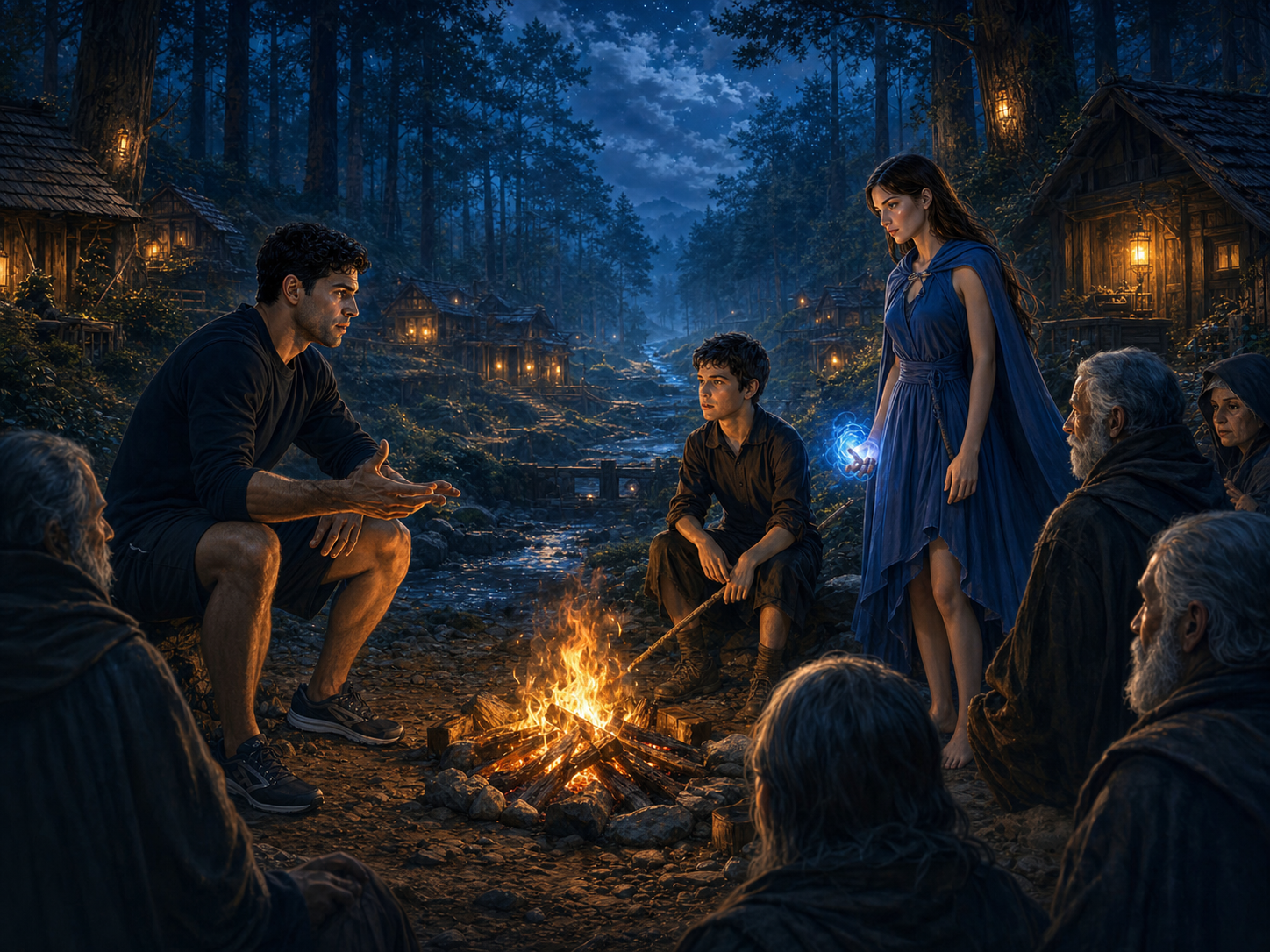
Outside, a fire crackled low along the river’s edge, hemmed in by a ring of dark stone polished smooth by years of flood and sun.
A group of villagers gathered in a loose half-circle. Some sat on flat stones, others on carved logs. One boy dangled his feet over the water, kicking idly as the glow caught his face in flickers of gold. Voices moved like the current—soft, layered, and constant.
Eirwyn crouched near the edge, arms folded across her knees, her gaze locked on the dancing firelight.
Drake stood between two stones, palms open near the glow. The warmth bled into his skin. His breath rose in the cool air, trailing off toward the branches above.
He looked at the boy standing across from him. The same one who asked about lying. He watched Drake with an eager look on his face.
“So,” Drake said. “Are you ready?”
The boy’s facial expression grew even more eager.
“I’m gonna tell these stories one at a time. The first one might not make so much sense at first, but you’ll see where I’m going eventually. Now, imagine a place packed with fifty thousand people. Think you can do that?”
A few people who overheard him tilted their heads and threw him halfway glances. The girl sitting nearest to them whispered something to her sister.
“It’s called a stadium. Built with brick, steel, and glass. Giant moving pictures the size of trees flash with color. Music shakes the bones. People scream so loud they drown themselves out and the stadium shakes.”
A woman cocked her head, the single braid holding her hair in swinging over one shoulder. One of the elders leaned forward, elbows on his knees, face aglow with interest.
“They call it sport. Millionaires—people with a lot of money—who are my age play them. Watched by people who work double shifts and go home broke. No lie.”
He let the silence hang. The boy near the river still watched, while the two sisters also locked their eyes on Drake.
“They argue and fight over it. Entire channels on smaller moving pictures built just to scream about which team is better. But outside the walls—those same cities rot. Families collapse, and politicians steal, smile, and tell us what else we should be angry at.”
Someone exhaled a sharp breath through their nose. Another man shook his head in disbelief.
Drake’s eyes caught the shimmer of embers near the fire.
“We call it distraction. But that’s too clean. It’s conditioning a society raised to react to noise, not act on principle.”
Eirwyn shifted. Her arms loosened, eyes never leaving his face.
An elder near the front lifted a hand. One with gnarled fingers that Drake hadn’t noticed until now. “So how do your people speak truth, then, if noise is all they know?”
Drake’s shoulders rolled. “Many don’t, and most won’t.”
He crouched by the fire. His reflection rippled in the water beside the stones.
“But some of us hide our voices inside machines. We scramble our names, wrap messages in something we call codes. We use VPNs—it’s a way to hide inside a machine. They look like nothing. But they’re like shields, or armor you wear without being seen.”
A low chuckle rumbled from the elder again. His voice cut across the quiet with dry weight. “You’ve hidden everything but your courage.”
The boy laughed next.
Drake looked at the fire before glancing at Eirwyn. Finally, he turned to the people who sat quiet but attentive. “I lost it for a while. But we had to do something, because those sports I was talking about—that’s how regimes keep people pacified. Bread and circuses, we call them. That enables their war machine back home. One hardly any different from Malcor’s.”
The fire crackled louder for a breath. Wind shifted, and the trees overhead leaned into the silence.
Eirwyn stood and crossed to the edge of the circle. Her cloak caught the light, blue silk catching embers like stars pressed into fabric, but she didn’t seem to mind. She kept up her stride until she stood beside Drake.
And in that stillness, the villagers down near the banks relaxed.
One woman leaned back against a tree and passed a dried root to the boy. An old man closed his eyes and murmured something beneath his breath.
Brewing moonlight spilled across the river and rising mist clung to the banks in low coils, dragging across stones and occasional tangled weeds. Water trickled steady through the valley, catching glints of light from the village fire.
Drake took a jug made of carved gourd from Eirwyn that the braided girl handed her, its rim chipped but still watertight. He crouched and dipped it slow, watching bubbles rise as the current pushed against his wrist and cold bit through his skin.
A twig snapped behind him.
Drake rose, water sloshing against his fingers. He set the jug down on a flat rock beside him.
She stepped into view, her cloak pulled tight, and brown hair cropped short. A scar ran across the bridge of her nose like an unfinished sentence. Her eyes were hard, blue-green, and unflinching—locked on his face.
One hand rested on the hilt of a blade no longer than her forearm. “We’ve survived,” she said, voice low, “because we trust slowly. It’s one reason Malcor won’t send his people in. Yet, anyway.”
Drake shifted, his feet shoulder-width. “You’re not wrong.”
She took two steps forward. Her boots barely cracked the gravel.
“The tradeswoman negotiating that deal with you wasn’t just voluntary exchange,” she said. “It was a test.” Her gaze drifted to the jug, to the water, then back to his face. “You speak well. Too well.”
The blade stayed sheathed, but the weight of it shaped the air between them.
“I couldn’t speak openly before.”
She tilted her head. “You think that story bought you ground?”
Drake met her eyes. “It had enough value to buy me and Eirwyn time.”
Her gaze flicked toward the village, toward the lantern-lit circle where a few children chased shadows and another group of adults whispered too close to hear.
She pointed with her chin. “That boy, the one who asked about lying to regimes and you gave him a sports story.”
Drake followed the glance. The boy now stood near the edge of the clearing, playing with a carved stick like it was a sword.
“Don’t teach hope, unless you plan to fight for it.” She turned and walked away, boots crunching soft over gravel.
Drake stood alone at the river’s edge, moonlight cutting across his shoulders. The jug sat full beside his sneaker.
Eirwyn gave him the same kind of smile his mother gave him when they would make eye contact.
He picked up the jug, and waved her over and they stepped toward the edge of the grove—a break in the tree line where moss-covered stones formed a quiet arch. Leaves hung heavy above, dripping with dew as wind pushed past them.
Drake kept his head up. He knew they were being watched. Eirwyn—for now—was his only true friend here.
Chapter 10: Innovation
The following morning, Drake and Eirwyn visited the market. One that, astonishingly, moved like a limp animal.
Drake, dressed in more traditional attire with long pants, boots made from dragon hide, a tunic, and a brown cloak, leaned against a post beside a crate of dried mushrooms. He crossed his arms, eyes tracing every slow exchange and trying to avoid the gazes of those passing by who threw the occasional suspicious look his way.
Three stalls across, a man lifted a bundle of smoked fish, waved it high, and shouted something toward a weaver half a field away. The weaver looked over and shrugged, then a child bolted from the shadows, legs pumping, her single braid bouncing as she sprinted toward the inn with a scrap of paper clutched in her fist.
Two elders argued near the dye booth. They talked over each other, hands gesturing like old trees in the wind. Drake watched the same woman walk past him for the third time in an hour, her arms full of herbs wrapped in cloth. Every time she passed, her frown deepened.
Behind her, someone kept demanding ashroot, only for each vendor to reply with an apologetic look on their face.
Slate runners—mostly kids the same age as the boy who spoke to Drake yesterday—dashed between stalls. They copied trade tallies, rubbed out others, and glanced between symbols like the world would break if they made a mistake. One nearly tripped over a goat, then vanished behind the water wheel.
Across the stream, a woman hoisted her skirt and marched uphill toward the far gardens Drake hadn’t noticed the previous day. Breathless, she locked her eyes on a pouch of herbs strung from a hook. By the time she reached it, she’d crossed a good half-mile of uneven path, burned a quarter hour, and passed four other vendors who sold the same thing.
Drake’s fingers twitched against his bicep. Part of him wanted to say something, but the part that told him to sit back and keep observing won out.
A boy called from across the ravine and another boy answered. They shouted back and forth, their voices loud, impatient, and unclear. Finally, both ran in opposite directions, each chasing a question the other hadn’t fully asked.
Drake stared at the chaos. Then at the transaction records stacked outside the inn. The owner who checked in Drake and Eirwyn yesterday and her son read the cracked slates. Worn chalk rolled nearby, three lines were marked where there should be two, and someone had drawn symbols that didn’t match. A slash that looked like a trade but could’ve been a name. The woman cursed under their breath, crossed out a mark, rewrote it, then paused, unsure.
Drake’s jaw clenched. “There’s a thousand ways to fix this,” he said in an undertone.
A shadow crossed the sun, then crouched beside him.
Eirwyn, wearing a less-battered blue cloak, the front of which, like her other one, ended at her thighs, balanced on her toes near the crate of mushrooms, her eyes scanning the same pattern of slates and scrambling children.
She plucked a stem from the crate, and rolled it between her fingers until the edges crumbled into flakes. “Did you say something?”
“Are you entertaining yourself?”
“That wasn’t what you said. I know that much.”
“Alright, fine. I said there’s a thousand ways to fix this.”
“Then fix it. Or stop complaining.”
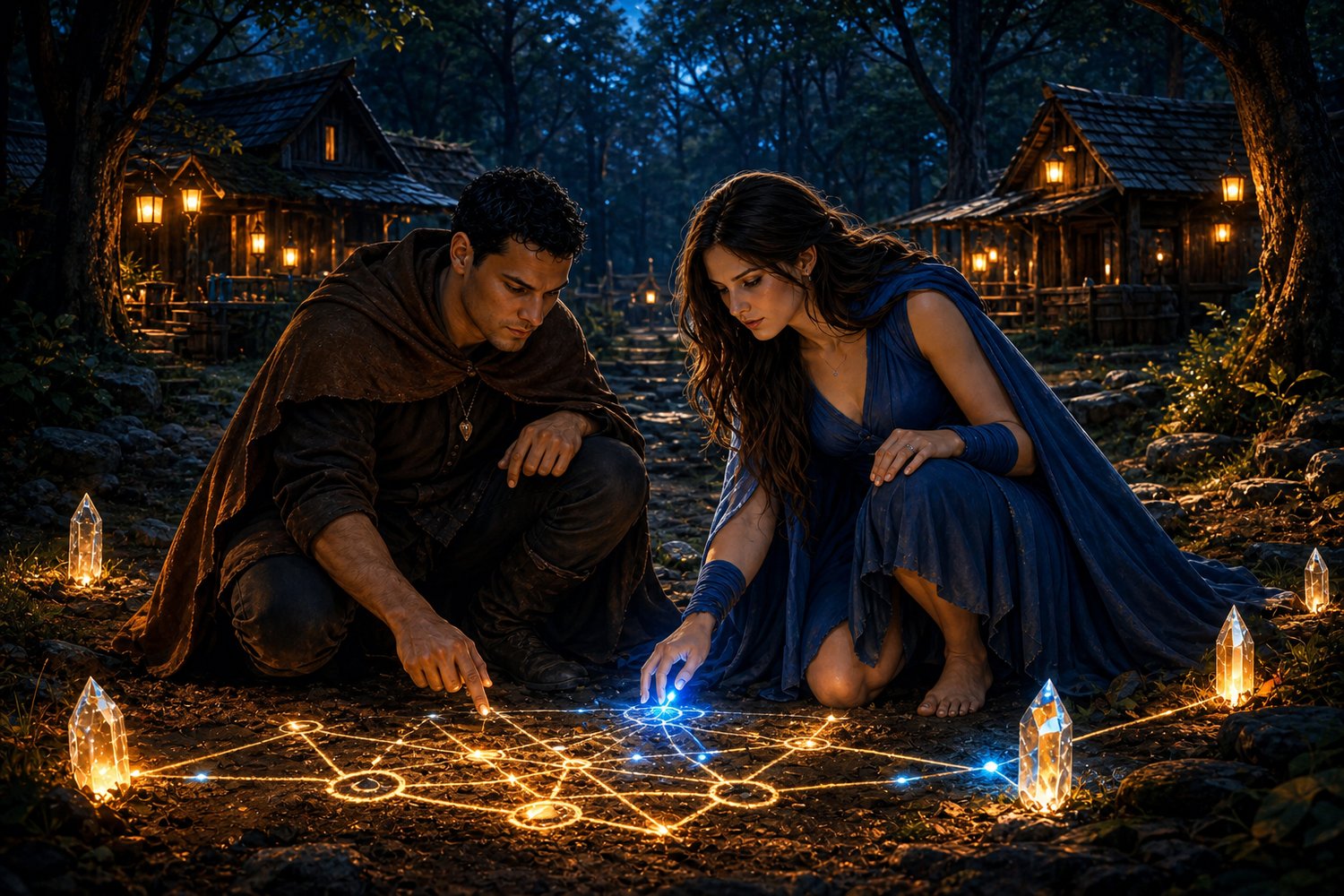
Drake looked sideways at Eirwyn as she flicked the crumbled stem into the dirt. He crouched in the dust and dragged a finger through the soil.
The lines came in fast, clean angles, sharp pivots, and points connected in a triangle. Then another, then five more. He linked them with curves, stretched arcs between corners, and the picture grew, rippling outward. He drew concentric loops and spiraled intersections. It was a map—but not of roads.
“In my world,” he said, voice low but deliberate, “we have networks. Threads that carry information, and messages broken into pieces, fired across lines. Not top-down or orders. They’re pulses passed peer-to-peer.” He tapped the center of the design, where three triangles surrounded a fourth.
Eirwyn crouched beside him, looking puzzled. “What are you making?”
“It’s a node with a sender and a listener. As long as it can catch a signal and pass it along, the message lives.”
Eirwyn leaned closer, strands of her brown hair brushing his arm. Her knees pressed into the dirt without concern as she rested one hand on the edge of a broken crate; the other curled near her chin, fingers twitching like they wanted to move the shapes he’d drawn. “Messages?”
“Think of it like pigeons. Only faster. Like invisible birds. You give each one a scrap, send them out, and instead of flying all the way to one person, they fly part of the way. The next node picks it up, then the next. Until the whole thing reaches the target.”
Eirwyn pointed to the loops. “And those?”
“They’re echoes. A message can split and find multiple paths. If one fails, another picks it up. Like built-in resilience.”
Eirwyn shifted her weight, her eyes tracking the loops. Her gaze skimmed the grooves like they contained runes she’d forgotten how to read.
Drake extended the metaphor. “Now replace the pigeons with pulses that emit short bursts of sound. Not words or anything, but tones. Vibrations with an encoded meaning. Are you following?”
“A little.”
“If there’s a way in this world to connect them like this, then it’s problem solved.”
Her brow drew tight. “Magic can carry sound,” she said, her palm glowing. “But it drifts and loses shape unless someone or something’s controlling it. Wind scatters it, water muddies it, and even silence pulls it apart.”
Drake smirked. “If it rides the right carrier, we’re good. Like how you told the forest that you passed through it.”
“Yeah, you can say that. Is that where you got the idea?”
“Probably.” He reached into his cloak pocket and pulled out the cracked phone screen. He held it up between two fingers, then turned it sideways so the glass caught the sun.
Eirwyn narrowed her eyes.
“That screen once held every thought I’ve ever published. Every reader, reply, and basically my whole life. Now it’s useless. Even if I could turn it on, it’d still be useless because the carrier couldn’t emit a signal in this world.”
He tapped the earth again, beside the central triangle. “But what if your magic is the carrier? There’s a vibration there, and it can route from node to node, stabilized with mirrored marks and something like glyphs can shape them.”
Eirwyn dragged the edge of her cloak over her lap and brushed away a streak of pollen. “You’re talking about building a message path. Like one in your world, but with this world’s resources.”
He nodded. “I’m talking about building a network with magic.”
A gust of wind passed through the square as two nearby traders argued over squash and a child dropped a basket and ran to the stream.
Eirwyn cocked her head toward a nearby hillside, where quartz jutted in jagged seams, veins of fractured light wedged deep in the dirt. Some split the slope while others pulsed faintly, their veins alive with a dull glow that shimmered even without spellcraft. Sunlight peeking through the clouds caught on the edges, and the ridge burned gold, blue, and white.
She stood and waved Drake over. “I can shift magic into them. Quartz can retain its shape.”
Eirwyn pressed her palm to the largest shard and traced a shape. She tilted her head and closed her eyes, humming a low, single note across the surface. Light curled inside the crystal and it pulsated with even more frequency.
Drake knelt beside a smaller spike, his fingers brushing stray dry grass from its base.
“Touch it there.” She pointed to a notch chipped into the edge. “Then trace the containment glyph. Spiral in. Sharp corners, not curves.”
“I can do this too?”
“We all have magic in us. Witches like me are just born with more of it, but I’m on the run. I can’t stay here and tend to this network forever. If you do this, then they’ll know that they can, too.”
Drake nodded, and slid his fingers over the stone. It pulsed once beneath his skin. Nothing like what Eirwyn did, but still, he had something here.
He concentrated more, and the glyph came slow. His nail carved through loose dust—half a spiral, two cuts intersecting through a sharp point at the center. He moved with precision and kept his breathing steady, copying the exact shape Eirwyn drew. It felt like the moment just before a current jumps a wire.
“Now hum,” Eirwyn said, sidling beside him, her cloak brushing another batch of quartz. “Match what you hear.”
He paused, then leaned close. Something stirred beneath the crystal. It was like pressure shifting, like the moment between lightning and thunder.
Drake picked the lowest pitch in his chest and pushed it out slow. The crystal flickered. It was dim at first, then it grew steadier.
Eirwyn’s hand shot up. “Stop there. That’s the tone you need.”
He backed off half a breath, and the glow faded but didn’t vanish.
She drew the same symbol on three more and repeated the process. “Give me two more. That gives us seven, a number associated with magic.”
Drake drew three more spiky spiral shapes with his pointer finger.
“Now say something into it and see if it works.”
“Test. Hello. Return,” he said, voice low, speaking into the quartz.
Eirwyn tapped the center stone; one of the stones Drake drew. “This should be your main beacon and the other six should move power to it. Watch it.”
She stood and paced to the far side of the ridge where a narrow trail sloped into thicker woods.
Drake watched her vanish past the rock line. Only the top of her cloak showed, then a shimmer of blue against a dark trunk, then nothing.
Then the air shifted. A flash—a glint off something mirrored. Light snapped from the hill’s far edge, and bounced once off a polished shard propped against a split post hammered into the ground.
The glyph on Drake’s shard lit, then faded.
He stared at it, watching.
The stone cooled, then the wind picked up, brushing pine needles across the ground.
A beat passed, then a grin spread across Drake’s face as the glyph shimmered after another beam of light hit it, complete with a radiant hum that lasted a few seconds. “We’ve got a signal.”
Eirwyn stepped into view and jogged back over. “More than a signal. The message worked. Test. Hello. Return.”
“You heard them?”
“I did. It was faint, but there. If we create a second beacon, the message should come in clearer and this world will have something. Something it never would have had if I got stupid on the day we first met. Now let’s go show the rest of the villagers and see what they think of it.”
Chapter 11: Market Forces
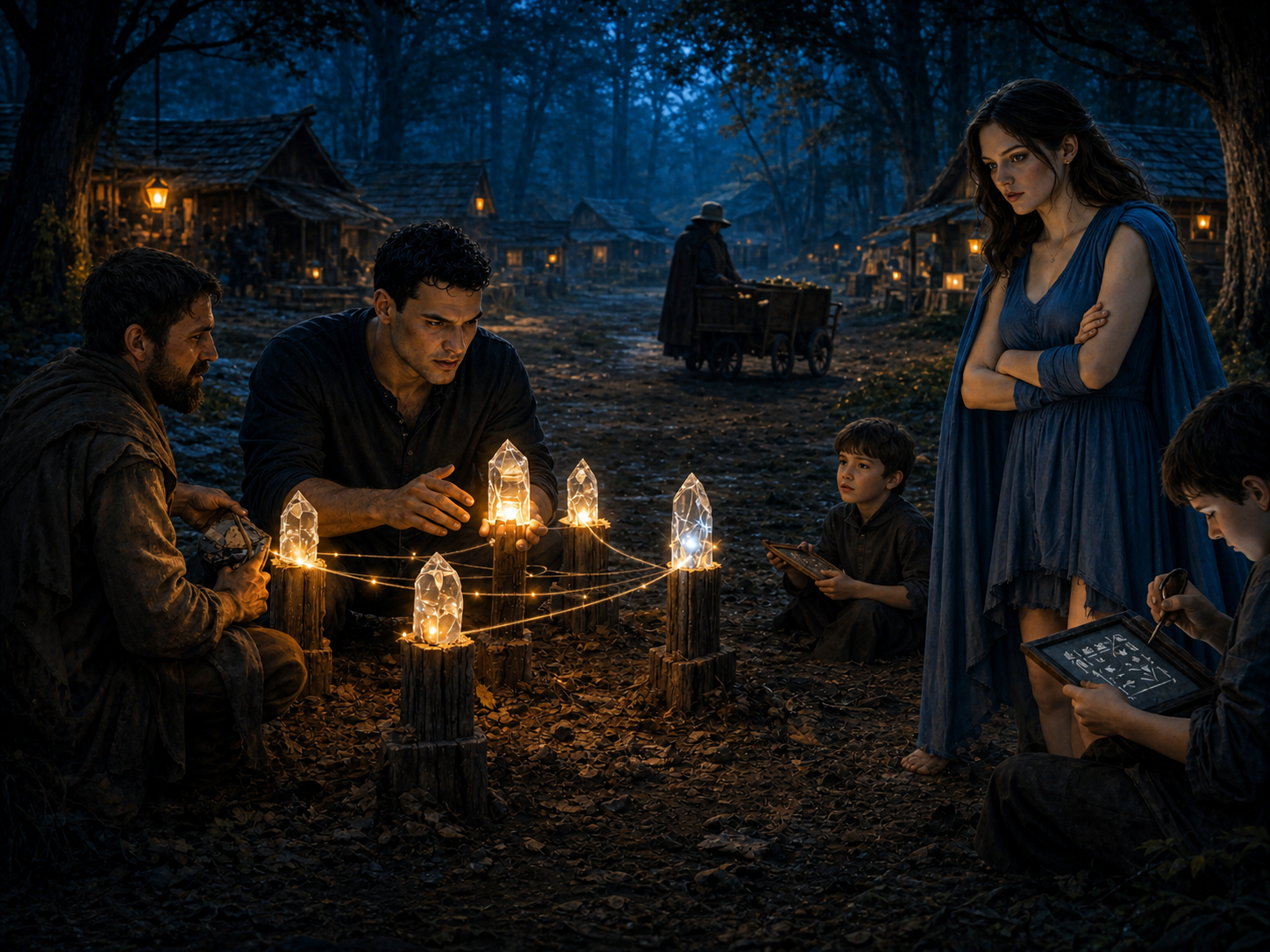
The fire crackled at the edge of the square—coals glowing under a dusk sky washed violet and gray. Smoke drifted through the eaves, catching in the moss that clung to every beam. Villagers ringed the stone circle in tight clusters: elders on low benches, traders with stained hands, and children sitting cross-legged in the dirt.
Drake stood by the central log table, with two crystals mounted on carved posts flanking him. One pulsed faintly, and the other sat cold.
Behind him, Eirwyn stood—arms folded, her bare feet planted.
A younger merchant around Drake’s age leaned forward, eyes narrowed. “It blinked once. And then what?”
Drake knelt beside a cleared patch of dirt, scraped his palm across it, then arranged the quartz in the same pattern of six surrounding the seventh, before transferring his energy into and emitting a low hum.
Drake’s finger tapped the main quartz. “The signal travels in pulses. When mine and Eirwyn’s experiment worked, one group of quartz linked to the next group the second there’s magic or even human energy embedded.”
A stout man with rope burns across his forearms stepped closer. His tunic bore the fishhook mark carved above his stall. “Pulses vanish in air. I want records. Slates. Something I can read when the sender’s dead.”
“You’ll still have slates.” Drake nodded to the kids who were keeping track earlier and pointed toward the inn. “But now they can record everything faster.”
He set up another quartz circle, drew a line between them, and another branching off to a third landmark, this one representing the inn. “Trusted keepers wouldn’t need to run around all day. You pass the transaction through the quartz, and the kids record it on the slate.”
Drake pushed the dirt with his thumb, smudging the center line. “No one owns the whole signal. You buy your own quartz circles.”
Murmurs rippled. A potter whispered to a weaver, and one of the children mimicked the pulsating quartz pattern with her hands, sketching something only she could see.
Eirwyn stepped to Drake’s side. “No central overseers. Just tools you can buy from us that would make your life easier.”
The woman from the inn stepped through the ring of firelight, arms loose at her sides. She looked at the circles in the dirt and at the glyphs embedded into the quartz. “When would one find time to make these tools?”
Smoke curled from an old mill’s chimney. It was thin and sweet with burning juniper. Sparks danced above the eaves as a contingent of the village bent itself to the work.
Eirwyn motioned toward a pile of quartz she and Drake scavenged from the ridge. “Me and Drake can make them. Even improve them to where they could reach the next town over.” A warm smile crossed her face. “It could turn into a quiet dissent against Malcor.”
“And it’ll buy us more time in that inn besides my limited number of stories if these quartz circles sell.” Drake reached for the quartz and traced the glyph Eirwyn showed him earlier today—a spiral with sharp corners and no curves. His hands moved with purpose.
Children crouched at the edge of the clearing, etching the marks into bark slabs, as though believing the wood could emit a signal. Some used bone-tipped styluses. Others worked with charcoal, their fingertips stained black and smiling like they’d stolen fire.
By nightfall, Drake and Eirwyn built and tested quartz groups at varying distances: behind buildings, from the center of the village, and even from one end of Cinderglen to well off into the trees.
At times, the signals lit up. Other times, they fizzled, leaving the innkeeper’s boy to take notes on a slab for record-keeping on their progress.
A girl raced from one house, laughing as she waved a flickering discarded shard no bigger than her thumb. The glyph on its surface blinked randomly, and by the time they wrapped up, Drake and Eirwyn handed other kids their failed experiments while the successful ones stayed embedded in certain parts of town.
By the following evening, willing merchants testing Drake and Eirwyn’s experiments had fewer kids walking or running to confirm trades. Instead, the merchants set up shop near one group of quartz, and the kids standing near other groups in the village recorded the trades.
Drake stood at the edge of the square, arms crossed, watching a boy no older than ten trade two of his father’s dried fish for a pouch of bitterroot before speaking into the nearest set of quartz. Near the inn, a girl nodded and wrote up the transaction on the slab.
Drake’s breath fogged just slightly in the shade as he and Eirwyn watched magic moving as a utility. “At least we have a basic framework down. Now we just need to figure out how to work around obstacles that are blocking some of the signals that are farther away.”
Eirwyn bit her lip but shrugged. She gazed at the forest and shivered, the look on her face unreadable.
“What’s on your mind?”
“Malcor. I was thinking about him last night. His huntsmen, soldiers, castors, and whoever else he has now. He might not enter this village yet, but it’ll get obvious when nobody has seen hide nor hair of me.”
Ash settled over the square like slow snow—flakes drifting from the chimney above the tanner’s hut, catching in the slanted sunlight. The air smelled of wet hide and faint copper as Drake leaned against a post.
“Drake?”
Drake kept his eyes on the messages passing between the quartz, replies echoing as they played calls and responses. “What were you thinking? You sound like you want to stay here, but…”
She leaned on the other end of the post. “I’d never forgive myself if Malcor figured me out and invaded this place, because we both know he would. You’ve seen what they do to villages.”
Near the edge of the square, a blacksmith wiped his hands on his apron, lips pressed thin. His hammer sat untouched on the anvil. The fire in the forge smoldered low, leaving no bellows pumping. Two children passed his stall and headed home, their work completed for the day.
Behind the mushroom drying shed, a tanner tossed a length of leather over the rail, muttering low. “People starting to talk through crystals now. They’ll forget how to speak face-to-face before long.”
Drake wore a half-smile. “If this fails, they’ll just force us out anyway.”
A goat bleated from inside the pen, but the rhythm of the village had shifted. It was smoother and faster—but quieter in places where conversation made the place come to life a few days back.
Eirwyn, as though noticing this sudden change too, nodded. “They weren’t running around as much, but they made a lot more trades.”
At the next post, one of the elders stood with her arms folded, her robe fringed in sunburst thread faded with age. Her gaze followed the nearest sets of quartz. When Drake stepped beside her, she gave him a sideways glance. “Every innovation comes with a cost, you know?”
Drake rolled back his shoulders until he stood at full height. “It’s a market disruption. There’s a trade-off now. But if people see benefit and value in it, then mine and Eirwyn’s invention will stay.”
Eirwyn glanced at Drake and wore the faintest trace of a smile, though she still looked uncertain.
The elder studied the dirt, then her eyes flickered to him, before turning and walking away.
***
From across the square, the scrape of steel echoed the next morning—a blade drawn slow along whetstone. Eirwyn crouched in the shadow of the inn, cloak pooled behind her, the curve of a dagger that she bought with her and Drake’s first payment from those who decided to keep using the quartz—nearly everyone who tested it the previous day—flashing orange with each pass. “We need to make sure no one messes up this map. It has all of our quartz circles labeled.”
As the edge gleamed, her wrist flicked again, and the steel blade hissed in reply.
The morning sun peeked through the clouds with a wind sharp enough to sting the eyes. Smoke lifted slow from Cinderglen’s chimneys, curling through bare branches and across rooftops still slick with dew. The square stirred before the sun fully claimed it as boots crunched dirt and gravel, satchels slung over shoulders, and voices rose in fragments of trade and laughter.
At the edge of the village square, a woman unwrapped a parcel. She retrieved dried fennel, frost-root, and sprigs of purple threadmoss. Her breath caught as she laid the herbs out across her stall. The boy beside her recorded something on his slate.
Across the path, the blacksmith stepped back from his anvil, his jaw slack. He turned to the crate beside him, and cracked it open with a crowbar.
Coiled copper. It was clean, and hammered flat for shaping.
Drake watched from the edge of the inn. He traced the motion of the village with his eyes, and the way people moved differently now. Even fewer legs ran today and more kids worked the slates while others took calls from the quartz. A burst of color across the sharp spiral glyph perched off a quartz circle near an old oak beside a waterwheel. Quick flashes, immediate answers, and fast and accurate record-keeping that multiplied.
Value found its channel, even as a few vendors shot the others distrusting looks and sent their kids running across town to manually deliver the messages.
Fresh marks sprawled in concentric rings as kids recorded each transaction on growing piles of slates. Chalk dust clung to grubby fingertips and worn sleeves. One slate bore ten entries—each a single line: giver, taker, what passed between them, and if necessary, for how much. Another chalked three loops, then drew a fourth with a smirk and a shrug.
A girl near the back tapped her chalk against a glowing quartz in the stone. It pulsed once, and she leaned in to listen to the message before recording it.
Eirwyn stepped beside Drake at the threshold, looking protective of her map as she sheathed the dagger into her cloak. She watched the movement with the same intensity she gave to forest trails and wind patterns days ago.
They stood together, with Drake recording the occasional note and Eirwyn’s eyes flickering back to her map.
Mist clung low to the square as the day drew on, and lanterns flickered along the main street as the sun set.
Something caught Drake’s eye as a figure approached in the distance. Eirwyn must’ve seen them, too, as her breath hitched.
A peddler arrived under fog and silence, the creak of his cart’s wheels and the metallic jingle of harness rings announcing his arrival.
His cloak swept the mud behind him, soaked deep at the hem. But his boots stepped too clean for the road he traveled, likely the one that emerged before Drake and Eirwyn entered the village. Given the way the villagers acknowledged the man, it showed he was a familiar face.
He went from vendor to vendor, making his rounds quick. First stall: copper chisels for dried apples. Second: a pouch of greenroot swapped for arrowheads. Third: mushrooms, bone powder, and thick thread. He knew the exact weights before scales came out, and what to offer before anyone opened their mouth.
The quartz went off as vendors spoke into them and echoes and distant scratching told Drake that the kids quickly picked up and recorded the messages.
Eirwyn crouched beneath the overhang beside the inn, one knee pressed into the wet moss. The wind caught her cloak and flattened it to her side. Her eyes tracked the peddler’s hands, the way his fingers moved too fluid across his belt pouch.
He asked about the quartz circles and how they worked.
Drake leaned against the inn, a hand in his pocket, waiting for someone to point in his and Eirwyn’s direction.
Eirwyn shifted her weight, and nodded toward the square where the peddler now leaned on a post and asked a third merchant about the quartz’ signal range. “I’m wondering where he came from. Even if they know him, I’m pretty sure he’s going to let other villages know about this.”
“And about you, too.” Drake stared down the peddler as the vendor pointed his way.
“Well, there’s no sense in running.” Eirwyn stood and sidled beside Drake as the peddler slouched over, his gaze flickering between them. “I’ll let him make the first move.”
Chapter 12: The Vector
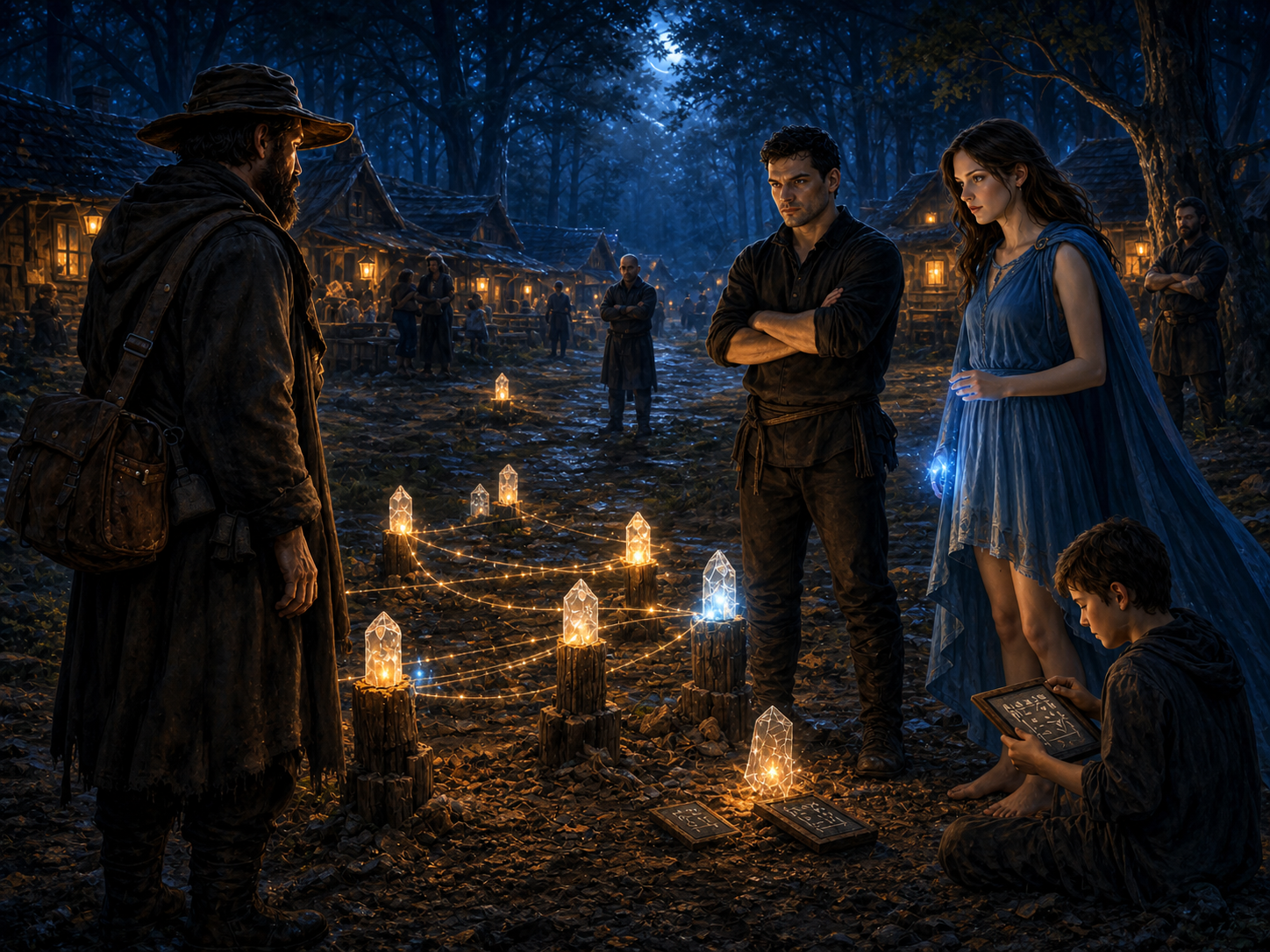
The peddler stopped a few paces short of them.
His eyes moved over Drake’s stance, then Eirwyn’s posture, then the nearest quartz circle. He took his time like he was reading a ledger written in flesh instead of chalk.
“You’re the ones.” His voice carried low, but it didn’t need volume. The square had already gone quieter as villagers turned to watch the conversation.
Drake shrugged. “Depends who’s talking.”
A flicker of something—amusement, maybe—crossed the peddler’s face. “A man who trades between places that don’t always agree with each other.”
Eirwyn’s eyes narrowed. “That’s a long way of saying nothing.”
The peddler shifted the strap of his satchel and let it rest higher on his shoulder. “Names don’t carry as much weight as routes.” His gaze drifted toward the nearest quartz circle as it pulsed. “And this…” He nodded toward the glow. “This will change routes.”
Behind them, a child spoke into one of the crystals, then another pulse and an echo answered from across the square.
The peddler watched that too. “You built a signal. One that moves faster than feet and carts.” He glanced toward the slate keepers near the inn. “And you tied it to memory.”
Drake motioned toward the square. “People wanted it. Most people, anyway.”
“People always want what saves them time.”
“Seems like it.”
“They rarely think about what it costs them.”
Eirwyn shifted her weight, one foot sliding in the moss. “You’ve seen something like this before?”
“Not like this.” He smiled faintly. “But I’ve seen what happens when one village moves faster than the rest.”
A murmur stirred somewhere near the stalls. The blacksmith stood just beyond earshot, arms folded again, watching the conversation.
“What happens?” Drake said.
The peddler looked back at him. “It gets noticed. Copied. Poorly, at first. Then better, then wrong.”
Eirwyn’s jaw tightened. “Wrong how?”
The peddler tapped two fingers lightly against his satchel. “Centralized.”
“They’ll try to control it,” Drake said.
“They’ll try to own it. Control is just the means to an end.” The peddler turned slightly, gesturing back toward the road he came from. “You think Malcor’s men won’t hear about a village where trade moves so quickly?”
Eirwyn’s lower lip curled as another series of pulses flickered across the square.
The peddler’s eyes tracked the rhythm. “They’ll follow the signal, not the people or the paths.” He looked back at Drake. “The signal.”
Drake’s arms tightened across his chest. “So what? You’re here to warn us?”
The peddler answered with the faintest shake of the head. “I’m here to understand whether this is worth carrying.”
That landed harder than anything else.
Eirwyn stepped forward half a pace. “Carrying where?”
“Everywhere I go. If I take this with me—if I speak of it—this stops being a village experiment.” His eyes flicked between them. “It becomes a market force. For now, anyway…”
The words hung. Behind them, a trader raised his voice. “Signal didn’t carry!”
A child answered from across the square. “It did—I got it late!”
Another child’s voice cut in. “Slate says otherwise!”
The rhythm cracked, but enough for the peddler to hear it. “Your system isn’t stable yet. That’s the window.”
Drake frowned. “For what?”
“For someone else to define it before you do.”
Eirwyn exhaled slowly through her nose. “You’re not just a peddler.”
“No,” he said simply. “I’m a vector.”
From the edge of the square, the female elder stepped forward. She pointed at Eirwyn. “You bring strangers.” Her gaze turned toward Drake. “You bring change. And now you bring attention.” Her eyes moved to the vector. “And you bring consequence.”
The vector inclined his head. “I bring options.”
Drake stepped forward. “Let’s say you carry and spread it. What happens then?”
The vector met his gaze. “Then you find out whether this was an invention or a disruption you can’t control.”
Behind them, another quartz flickered, then went dark.
A child’s voice called out from across the square. “It’s not answering!”
Another slate clattered to the ground.
Eirwyn turned toward the failing signal, her hand already moving toward her cloak as Drake’s eyes stayed locked on the vector.
Now, the question wasn’t whether the system worked. It was who it would belong to. Drake intended to spread this invention to the next neighboring town on his own accord. At some point. But if someone else did it for him without input, who knew what the consequences would look like?
Especially a vector.
Chapter 13: The Fracture
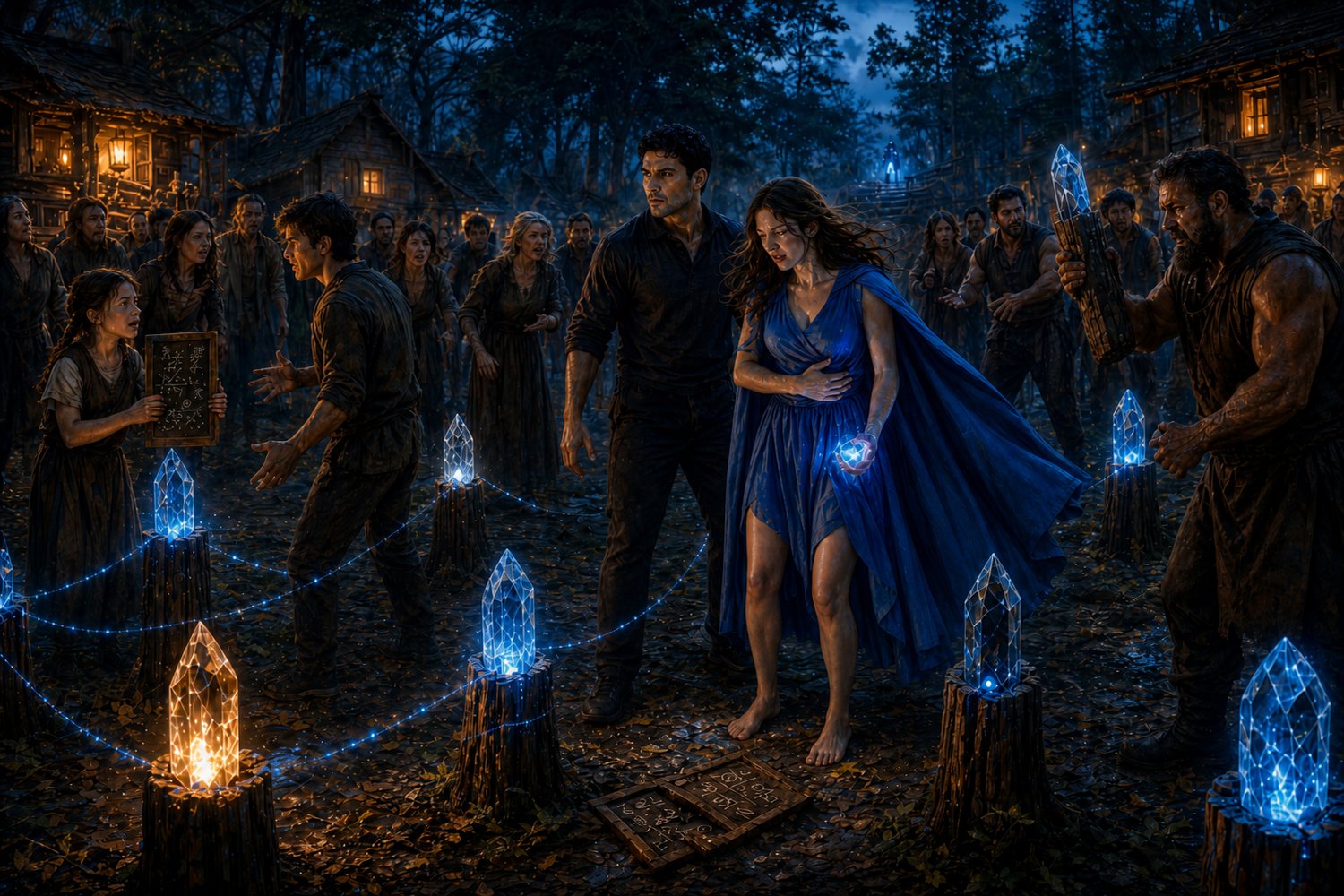
The pulse came back, but it stuttered at random times.
Drake heard it before he saw it. A stagger in the rhythm, like a heartbeat trying to find its pace again. The nearest quartz flickered, dimmed, then flared brighter than before. Across the square, another answered, but a beat too late.
Then two more, but they faltered out of sync.
A child raised his slate as the quartz circle nearest to him pulsed and a voice echoed. “It’s back!”
Another voice cut across him. “No—wait—it’s messed up. Mine says—”
The words tangled, and Drake stepped forward, eyes locked on the network. “It’s fine. It just needed—”
A second pulse hit. It was stronger, but it too flickered and died.
A girl near the far post looked over and nodded, her eyes straining as if trying to make out what the voice coming from the quartz circle nearest to her said. “It confirmed the trade. His trade.”
A man she pointed at shook his head. “No, it didn’t. I’ve got nothing left to trade today.”
She turned, jabbing a finger toward the crystal. “It carried! I heard it myself!”
Another voice joined in as murmuring erupted around the square. “I heard it too!”
“It was nothing I traded,” the man snapped, storming over and snatching the slate out of the girl’s hand before she had a chance to record anything.
Drake’s jaw tightened, racking his brain for a reason behind this supposed mishap. “It’s timing. That’s all. You’re not reading it at the same—”
“Timing?” Another girl lifted her slate and examined it. “Timing doesn’t give me two answers, right?”
“Two answers—?”
Another short pulse flickered in and died as a disembodied voice drifted across the village. The network responded like it couldn’t decide what it wanted to be.
Drake moved to the nearest post and crouched, his hand hovering over the quartz. The lines of light between the nodes shimmered. Some were steady, others were unstable, and a few lagged behind like a second thought. Their instability kept the center quartz from receiving a clear message.
“Stop talking over it,” he said. “You might be flooding the signal.”
The nearest boy looked up from his slate. “Flooding?”
“Too many inputs at once.” Drake turned to the next quartz circle near the girl before his eyes traveled back to the boy. “You’ve got to stagger it. One message at a time.”
He faced the square and raised his hands, his gaze lingering on the kids recording transactions that may or may not be correct. “Everyone stop. Just—pause for a second.”
A nearby girl with dark brown pigtails dropped her chalk and looked up. “My last one says she traded him two sacks of grain for coin.” She pointed toward a middle-aged man and the woman across the square.
The man scoffed. “I never agreed to that.”
“It confirmed! The signal.”
“Then why am I not carrying any grain?”
Murmuring again broke out, and the voices rose until they came close to shouting. Some older villagers stormed over to the kids, demanding they see if there were any false transactions.
Eirwyn stepped back and beside Drake, her gaze shifting from one signal to the next. Her fingers twitched at her side, as if it was a nervous tick.
The blacksmith stepped forward and folded his muscular arms, throwing Drake a hardened glare. “You build something faster than trust, and this is what you get.”
Drake kept his eyes glued to the same randomly-flickering quartz circle Eirwyn stared at. “You get speed and coordination. From there, you get—”
“Confusion,” the blacksmith cut in. “You get people owing for something they never bought.”
A low and agreeing murmur followed the blacksmith’s proclamation. The same elder who spoke before stepped out from the edge of the square. “You’ve introduced something this village cannot verify. Not yet.”
Drake snapped his gaze her way. “That’s why we fix it.”
“And while you fix it? What do we do with the damage?”
Someone slammed a slate into the ground so hard that it echoed. “You cheated me,” said a voice, its accusation cutting clean through the noise. A younger man stood near the center of the square, chest heaving as he pointed at another kid, who glued her eyes to the fallen slate. “You told me it confirmed.”
“It did!”
“Then why is it not here?” He kicked the slate across the square. “Why does this say I still owe?”
“That’s what she told me!” The girl shook an accusatory finger at an older woman.
“That thing now has me in debt. The slate shows I owe for something that I spent my hard-earned money on.”
There it was, and Drake felt it before anyone said it again. The shift from confusion to blame.
Eirwyn threw a helpless look at Drake, but her voice stayed low. “This isn’t just failing.”
Drake shook his head. “It’s early. That’s all. They’re using it faster than it can—”
“Drake, someone is going to get hurt over this.”
“They’re arguing over grain.” His eyes lingered to the new dagger she kept tucked inside her cloak. “Not blades.”
“Not yet.”
Another series of pulses hit a quartz circle before their gleam faded and died.
A boy near the outer post frowned down at his slate. “It didn’t even answer this time. I didn’t hear nothing.” He tapped the quartz with his chalk and a faint flicker answered before it too went out. “It’s not answering,” he said, louder this time.
Drake turned, and the line between two nodes flickered, went dim, then snapped.
Silence rippled through the nearest cluster. Not the whole square, but enough to tell Drake that most people here began rethinking his invention.
Eirwyn’s eyes lifted past the network, the village square, the posts, and into the tree line. “Where is he? The vector?”
Drake didn’t have to ask who she meant. The man vanished amidst the commotion. Almost as though the vector planned for this to happen from the beginning. He came, watched, learned, and left. A chill slid through the back of Drake’s neck from realization of what kind of damage this man could do.
“He saw the full cycle,” Drake muttered. “And its problems.”
Eirwyn’s hand moved to her side and just beneath the cloak. Part of her brand emerged and emitted a sharp pulse. She inhaled through her teeth and winced.
“Eirwyn?”
Her gaze stayed fixed on the trees as she strained her face. She concentrated on something that wasn’t there, or so Drake thought.
“They felt that,” she whispered.
Drake frowned. “Felt what?”
“The signal. They’re close, Drake.” She fought against doubling over as her brand pulsed again. “They’re not just close to here. I can feel them.”
Across the square, a node went dark and didn’t flicker again. Then a second, then a third.
“No,” Drake said under his breath. “No, no, no—” He moved back to the center of the network, crouching again, his hands hovering as if he could hold it together by will alone. “It’s cascading. Something overloaded the loop. Listen.” He leaned in as multiple faint, echoing voices jumbled. “It’s trying to reconcile inputs that don’t—”
“They’re tracking it,” Eirwyn cut in, massaging her side as she crouched next to him. “He’s got another witch nearby. A conscripted one. A castor. It’s not a coincidence that this didn’t start breaking down until that vector arrived. The timing is almost too good—ow!”
Drake froze. Part of him wanted to help Eirwyn, who he could tell held back tears of pain and she fought tooth and nail against losing it in front of these still-murmuring people. But a distant rustling drifted through the trees.
A pulse answered from somewhere within the forest and the nearest quartz flared before it once again dimmed. Another child dropped his slate. Though he, like the others, probably thought it dimmed because of a failure in the village.
“It’s not ours.” Drake eased himself upward and guided Eirwyn—still clutching her rib cage—to her feet.
Every instinct he had pulled in two directions at once. Fix it and block Malcor’s witch’s and vector’s influence or shut it down.
Around them, the village fractured. Some stepped back from the posts, and others moved closer, desperate to get one last signal through and praying it’d be correct.
The blacksmith reached down and yanked the quartz crystal free and pointed it Drake as if it was a weapon. “That’s enough. We’re shutting it down. End of story.”
“You don’t get to decide that!” someone shouted.
“We decide before it decides for us.”
Another distant pulse. Closer this time.
Eirwyn spotted it and stepped in front of Drake, doing everything in her power to stand upright. She bent her knees slightly and stood with her bare feet shoulder-width apart, her cloak shifting with the movement, the blue catching what little light remained.
Her hand glowed with a controlled, focused beam.
Drake swallowed, his mind racing through everything at once. The design, flow, and outside interference causing the failure.
Eirwyn squeezed his arm with her free hand and pulled him close enough that he couldn’t ignore her.
Her voice dropped to a razor edge, so sharp that nobody would know how much pain she was in. “You need to decide right now—do we shut it down, or run?”
Chapter 14: Chain Beneath the Skin
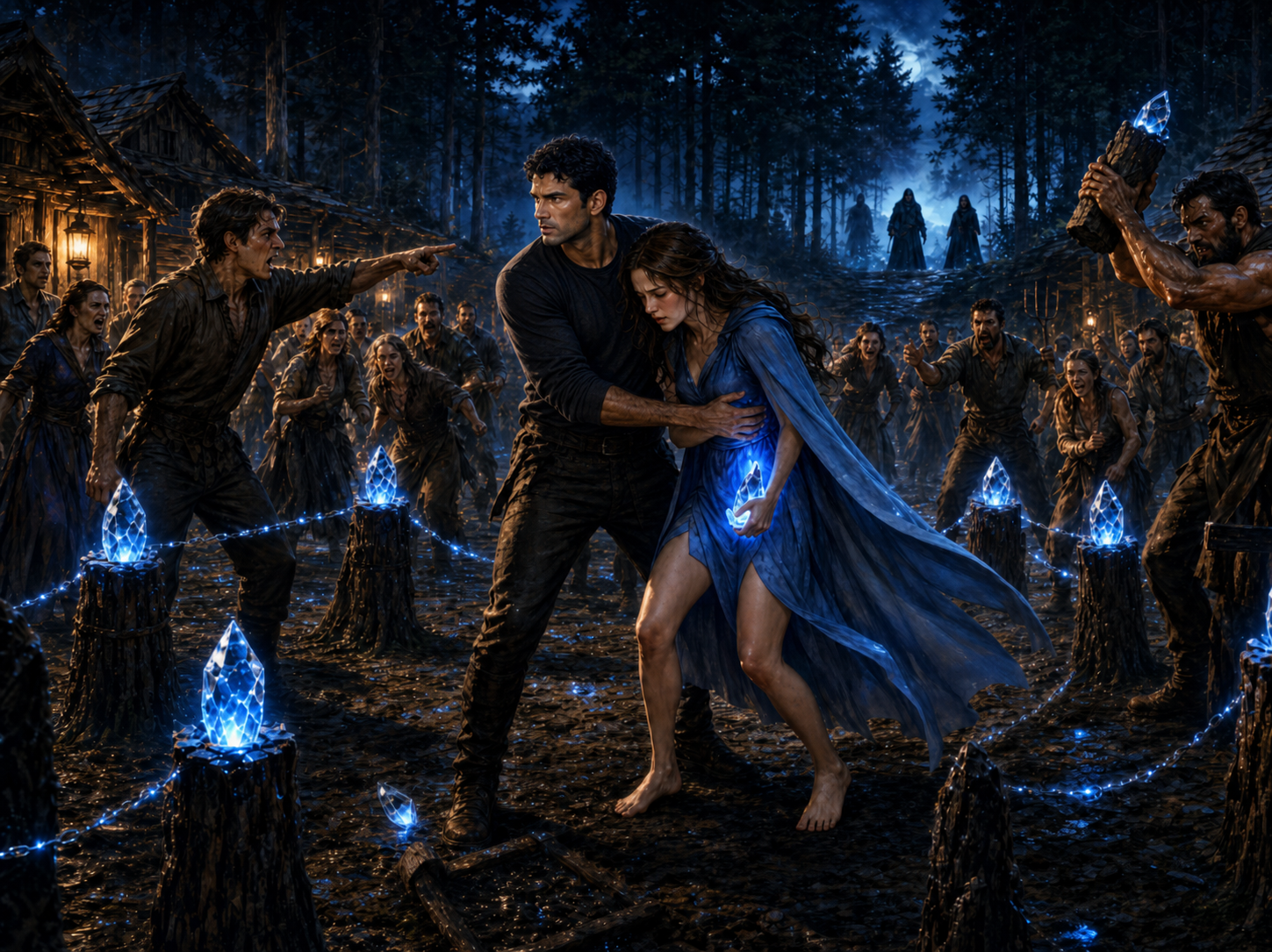
The first crystal shattered before anyone shouted another accusation. A sharp crack split the air, and blue light burst outward like a snapped vein, then died all at once.
Every head turned.
The blacksmith stood at the edge of the circle, chest heaving, the base of the quartz crystal still clutched in his hand. Its upper half lay in the dirt, dimming to nothing. “No more,” he said, his voice carrying.
Drake felt it. Not just the sound, but the shift. The moment something crossed from tension into fracture.
Around them, the network flickered.
Threads of blue light stretched between the remaining crystals—thin, and trembling. One blinked out, then another.
Eirwyn tightened beside him, her fingers digging into his forearm hard enough to hurt.
Drake turned. “Eirwyn, talk to me.”
Her head dipped, shoulders locking like her body braced for something it couldn’t stop. Then she gasped, her face screwing up in more pain than Drake had seen from anyone. Her jaw clenched and her breath ran short. Eirwyn’s eyes unfocused like that brand on her side just caught fire. Her hand—still glowing—jerked back toward her ribs.
“Eirwyn. Say something.”
She doubled slightly, one knee threatening to give. “I—” Her voice broke. “They’re—close. W-we can’t run…”
Drake’s stomach dropped. “Who?”
Her answer came through clenched teeth. “Castors. H-he’s sending…”
Drake’s hand found Eirwyn’s shoulder as her voice again broke.
Another crystal flickered, then went dark. A ripple moved through the crowd and they started murmuring again. Whatever these castors were doing to make this happen, Drake didn’t know. Did they have their own crystal quartz? Was there another batch of them somewhere in the tree line that he didn’t know about?
But Drake knew one thing: These castors did the same thing the people in power back home did. They used leverage to spread fear, outrage, distrust, and suffering among the masses.
“You see what this does?” someone shouted. “This puts our village’s safety at risk!”
“It was working!”
“Working until it wasn’t!”
“You don’t smash the whole thing because of one failure!”
“Failure?” The blacksmith took a step forward, raising the broken crystal. “You call this genius? We just lit ourselves up for the Crown!”
It was as though the blacksmith knew a thing or two about who lurked within the trees.
Drake scanned the edges of the clearing, narrowing his eyes as he looked as far into the forest before the trees thickened and he could see no farther.
These castors were masters of stealth, that was certain. Of course, they were. Eirwyn all but snuck up on and caught Drake off guard when they first met. The feeling these castors brought was no different from what Drake felt in that cave. Like pressure was building behind the world itself. That overabundance of energy wreaking havoc on this village.
Eirwyn staggered, and this time she could no longer hide her agony. Her hand clawed at her side, fingernails brushing hard over the place where the brand sat beneath her skin.
The glow changed. It was no longer the clean blue of her magic, but jagged and uneven. Something thick and black leaked through her fingers. It looked like blood, but the substance was darker. Almost like grime.
Drake grabbed her shoulders. “Talk to me. What’s happening?”
“They’re near,” she said, barely above a whisper. “Too near.” Her breath hitched again, “It burns when they’re close but… apart.”
Drake blinked. “Apart from the castors.”
“Yeah.” Her eyes snapped up to his. Another pulse hit Eirwyn and she sucked in air before breaking into a cough. “Th-the closer they g-g-get… the worse i-i-it gets.”
Behind them, a child cried out as another crystal dimmed. The network wasn’t collapsing cleanly. It was unraveling, and something told Drake that the castors sought to instill panic. Destroy the system quickly, and they wouldn’t get enough of that fear, outrage, and distrust. Let it die slowly, and the panic in front of Drake crept in and neared a crescendo.
One node near Drake stayed bright while another faded and died. A third flared too strong, and the light snapped between posts in uneven bursts.
A man stumbled back as a thread of blue energy sparked too close to his arm and missed him by mere inches.
“This is wrong!” someone shouted. “It’s unstable!”
“It was stable before you broke it!”
“I didn’t break it—he did!”
Voices collided as the man pointed an accusatory finger at Drake. One group backed away from the collapsing network, but another group stepped closer, as though seeking to save it.
Yet another group stood watching and waiting, as though torn between approaching the network, retreating, or joining the shouting mob that all but wanted to toss Drake out of this village.
Eirwyn dropped to one knee, her hand tearing over her ribs like she could rip the pain out. The jagged branding pulsed more violently, still spewing that strange liquid.
Drake knelt with her. “Stay with me.”
“I can’t—” She twitched and fell to her side, her head resting on the cool earth. “It’s unbearable.”
“How close are they?”
Her lips parted, but the answer didn’t come as Eirwyn rolled onto her back, eyes half-closed as she sputtered and choked.
Shimmering and a low hum came from the trees and the entire clearing went still. Those arguing with one another and shouting obscenities at Drake whipped around, facing the tree line.
One of the elders turned toward the forest, eyes narrowing. “Did you hear—?”
A figure stepped between the trees. Then another. Before Drake knew it, he counted six castors. They were witches, given the familiar glow emitting from their hands. Each wore long, black cloaks instead of blue, like Eirwyn’s. Also unlike Eirwyn, they wore boots, all of which took deliberate steps toward the village. The air grew stale as they drew nearer. Like a drop in pressure before a storm.
Eirwyn’s back arched, and a raw, involuntary cry tore out of her as the brand burned hotter.
The first witch stopped at the edge of the clearing. Even from this distance, Drake made out the mark at her side pulsing beneath the fabric. The same exact brand torturing Eirwyn as she lay, dry heaving.
The witch’s eyes swept the village, recognition crossing her gaunt features as her eyes landed on Eirwyn. The other half-dozen witches emerged behind her.
The blacksmith lowered his arm. For the first time, uncertainty broke through his anger.
One of the villagers whispered, “They found us.”
“No,” another said. “They were led. I’d bet you anything it was that peddler.”
Drake’s jaw tightened as he pieced everything together. He and Eirwyn all but disappeared. Malcor must’ve swapped out his huntsmen and usual conscripts, bounty hunters, or whatever, and deployed teams of castors to find Eirwyn. When they crossed that vector, someone who’d been to every village including Cinderglen, they had a lead-in.
The vector was their key, even if Malcor only conscripted people from here when they went on hunts away from the village. Nobody from here revealed Cinderglen’s location. But the vector, a peddler by trade, led the witches to it. Most likely when the price was right.
The lead witch took one step forward.
Eirwyn cried out again before she went still, lying spread-eagled as the hand pressing against her brand unclenched.
Drake took her limp hand to make sure the pain hadn’t killed her and she returned a faint squeeze. “I’m gonna get us out of this, okay?”
He had no plan or leverage, but he’d die before he’d let them take her or harm anyone in this village.
The witch’s cold gaze shifted to him and then back to Eirwyn. “She’s been running a long time.”
Eirwyn shook her head weakly as a small sob escaped her.
Drake glanced back at her, then forward again. Behind him, most of the villagers broke, running for their homes, slamming their doors and shuttering their windows. As if they thought their homes could protect them from a half-dozen witches and who knew who else? Technically, this village harbored a fugitive.
The remaining quartz in network flickered one last time, then went dark. casting darkness across a village that was no longer unified.
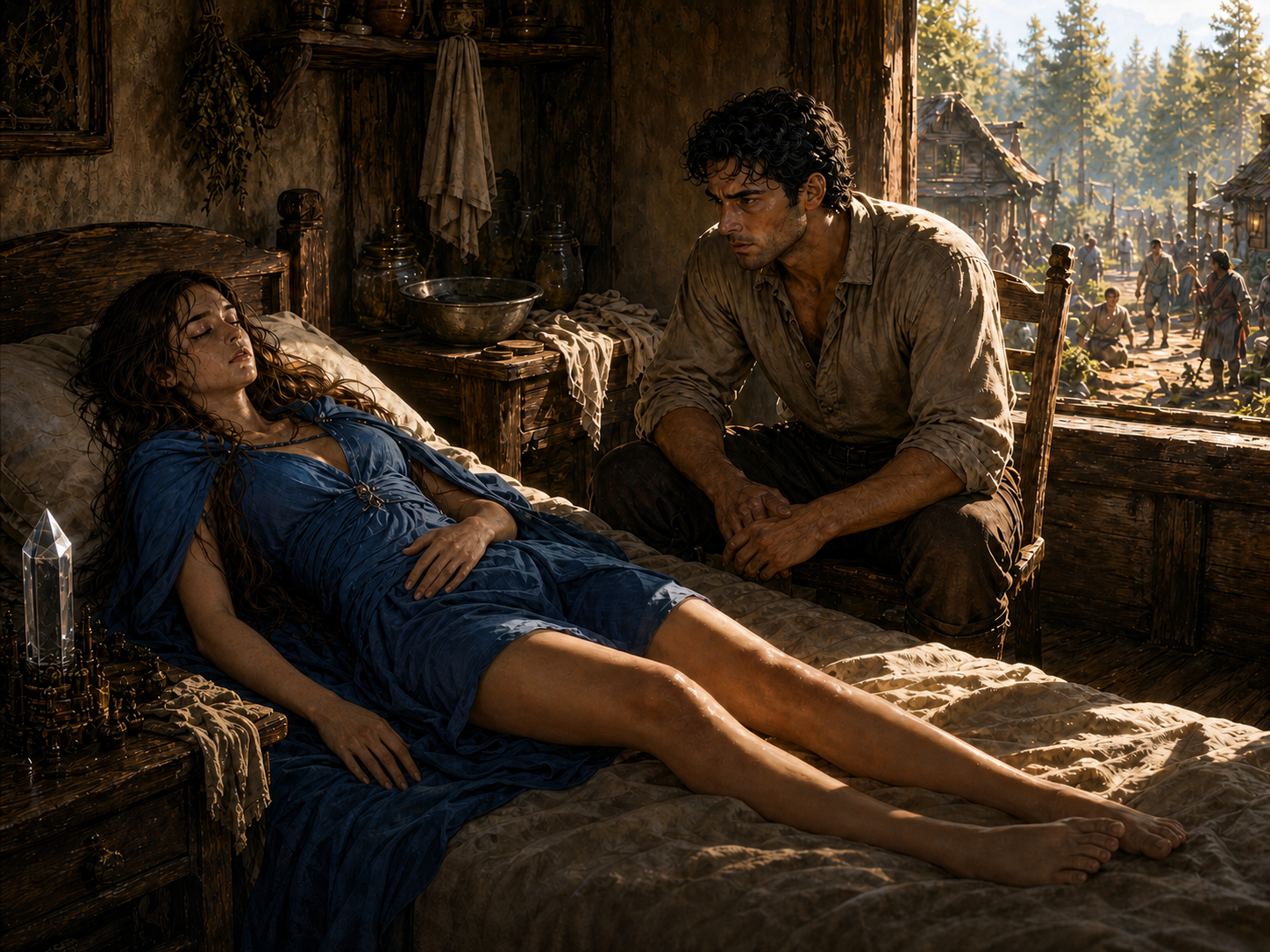
Chapter 15: The Cost of Holding
The first scream came from the village.
Drake turned at the sharp, guttural sound breaking through the chaos. A man stumbled backward, clutching his head, as one of the crystal nodes at his feet flickered violently, its blue light stuttering like a dying pulse.
Then it again went dark. A second node followed, then a third. The threads between those thin lines of blue that had once carried quiet order through Cinderglen snapped one by one, unraveling in midair like burned rope.
The air shifted around the witch nearest to Drake, wrong in a way he couldn’t name. It was like the surrounding forest held its breath.
Eirwyn gasped and her arm found Drake’s as the witches joined their leader and closed in. Her hand burned against his arm, like that red-hot pain inside her wanted to tear its way out. She tried to stand but her legs gave out as the witches drew to within yards.
Drake stood firm, planting his boots into the earth as he glowered at the incoming witches. He anticipated one or all of them moving him with one wave of their hand or with an energy blast.
Something rubbed against Drake’s pantleg, and from the corners of his eyes, Eirwyn eased herself upward, shaking as she dug her bare feet into the ground.
The witches stopped in unison and raised their right hands outward, as if seeking to hit their prey with a collective blast.
“Thought we’d do this the easy way,” the lead witch said. “Don’t make us hurt you further, Starweaver.”
Blue light flickered across Eirwyn’s palm. It surged, stuttered, then snapped into focus like a flame catching after too many failed sparks. Eirwyn took two steps forward as the witches sent a series of fireballs at her, but the energy in her hand absorbed them.
They shot another volley. Eirwyn stumbled and screamed in agony, but her energy again caught them. Her voice, when it came, was strained—but it carried. “You’ll either need to kill me, or I’ll make my magic collapse onto itself.”
Drake did a double take as his mind processed the weight of her words. “Eirwyn, no—”
“I’d die before I’d serve Malcor,” she said through gritted teeth, her voice barely audible. Eirwyn’s hand trembled as the light flared and the air snapped.
Whatever Eirwyn was doing, Drake had no idea. It was a brand of magic she hadn’t used. But the entire group of witches threw hurried looks at their leader.
In their hesitation, Eirwyn drove her hand downward as every crystal in the village relit themselves. Light tore across the ground in a jagged fracture of energy that split the gap between her and the witches.
The nearest witch shouted something and raised her hand. The others followed, but Eirwyn’s energy blast through the ground exploded with so much force that the entire village shook. A collective death scream erupted from the witches, but the lead witch planted her hand into the earth and absorbed the rest of Eirwyn’s onslaught.
The witch fired back, but Eirwyn, somehow, was quick enough to retaliate. The village quaked again as two forces grinded against each other with no room to give.
Drake staggered back a step and tripped, the shockwave ripping through the dirt beneath his boots.
Eirwyn screamed in a mixture of pain and effort. The light around her surged again—brighter, wilder, and uncontrolled. She was serious about her threat, and there was nothing Drake could do to stop her.
Every second cost what remained of her energy. Drake saw it as Eirwyn’s eyes again lost their focus. Her stance weakened, her shoulders dipped, and the glow in her hand, so powerful a moment ago, faded at the edge.
The lead witch saw this and grinned, pushing her own energy blast toward Eirwyn.
“Eirwyn—” Drake started.
“Don’t,” she snapped, her voice cracking on the word. But she held, finding a way to reflect her stagnating energy against the witch.
She fell to her knees and after one final shuttering scream, she encompassed the witch in a ball of energy, which transformed into an inferno. Now, the witch’s scream echoed across the village and the surrounding forest. She emitted energy beam after energy beam as the pale skin melted from her body until nothing but a charred skeleton remained.
Eirwyn swayed, and the light in her hand extinguished, snuffing out like a candle while the witch’s bone fragments dropped unceremoniously to the ground.
Then Eirwyn collapsed. Drake caught her again—this time with no resistance. Her body went slack against him.
“Eirwyn—hey—” His voice sharpened, panic breaking through. “Eirwyn, stay with me.”
Her breathing was shallow, but there. Barely, but that was enough. For now, at least.
He lifted her—arms under her back and legs—and turned toward the inn.
“Out of the way!” he barked at anyone who left the confines of their homes to view the damage. “Now!”
The inn smelled like smoke and damp wood. Drake forced the door open with his shoulder and carried Eirwyn inside.
“Upstairs,” the innkeeper said. “I have your room ready for you. I’ll make sure nobody goes up there tonight.”
Drake sprinted up the stairs into their small, minimalist room. It had a bed, a basin, and a chair. Drake always slept in the chair while he gave Eirwyn the bed. But tonight, there was no way he’d sleep until he knew if she’d be okay.
He laid her down carefully, pulling the thin blanket to her waist as her body trembled—then stilled.
Her face had gone even more pale. Too pale. But he heaved a sigh of relief when the back of his hand felt her cheek and the skin was still warm.
He took a cloth from the basin, rang it out, and dabbed it against her forehead, cleaning off the sweat, smudges of dirt, and other residue. Drake kept checking her breathing every few minutes as he wiped her neck and arms. He then carefully pried off the bottom part of her cloak and examined the branding, from which that blackish residue still seeped.
***
At some point throughout the night, Drake, now sitting, leaned forward, elbows on his knees, head bowed—not asleep, but not fully awake.
The first light of morning crept through the window in thin, gray lines some hours later.
“Drake.” Eirwyn’s voice was barely there, but it cut through everything.
He looked up.
She was awake, her eyes half-lidded, and still unfocused—but aware.
“Hey,” he said, too fast as his heart skipped a beat. “Hey—don’t move.”
Her hand shifted slightly against the blanket, but the glow in her rib cage had gone. Still, she winced.
“How bad?” he said.
She exhaled slowly. “Fading. Better than it was. But he’ll send another batch when they don’t return. Might send an entire brigade of them.”
Drake nodded, his jaw tight.
Eirwyn’s eyes drifted toward the ceiling. “They won’t leave me alone. Not after this.”
Drake leaned back slightly, running a hand through his hair.
Eirwyn’s gaze shifted back to him. “They were watching that vector. If they weren’t outright with him.”
“Yeah.”
“Malcor will punish the whole village for this.”
Drake let out a breath, then nodded. “Good.”
She frowned slightly. “Good?”
“Because now we know exactly what we’re dealing with. What this village will be dealing with. At some point.” He eased himself off the chair and stepped closer to the bed. “They don’t just want control. They need dependency, predictability, and systems they can monitor and break. That’s why they sent the vector in first.”
Eirwyn watched him, her eyes wide.
“So we don’t give them that. We don’t build something they can shut down. We build something they can’t control in the first place.”
Eirwyn’s brow furrowed and she fidgeted with the blanket. “You’re still thinking about the network.”
“Bigger than that.” He leaned forward, resting his hands on the edge of the bed. Part of him wanted to set one hand on Eirwyn’s shoulder, but he resisted the temptation. “We need to stay.”
Eirwyn bit her lower lip.
“We need to stay, help them, and fix what we broke. But not the same way. It can’t be so fragile.” He met her eyes. “We turn this place into something Malcor can’t overrun.”
Eirwyn studied him for a long moment, still grasping the covers with shaking hands. “You’re asking them to trust something that just failed.”
“No. I’m asking them to build something that can survive failure.”
Eirwyn shifted slightly—pain still there, but the look in her eyes carried a sense of resolve. “And when Malcor comes?”
“We make sure he regrets it. Just like he’s regretting sending those witches.”
Eirwyn closed her eyes again. “Okay then. We stay.”
 Catch Chapter 16 and dive deeper into Drake’s conversation with Eirwyn


